
Why Did God Make Me Different? Purpose in Disability

Written by: Christopher Gomez
Table of Contents
When you ask, “Why did God make me different?” the question may come from a deep place. It may come from years of feeling watched, misunderstood, limited, excluded, or tired. It may come from disability, visible difference, chronic weakness, or a part of your life that others do not fully understand.
The first answer must be gentle and clear. Being different does not mean you are defective. It does not mean God forgot you. It does not mean you are less loved, less useful, or less worthy of belonging in the body of Christ.
Scripture does not give a simple answer to every painful disability story. It does give a faithful starting place. God sees the person before He addresses the condition. Jesus did not treat people with disabilities as problems to solve, objects of pity, or lessons for everyone else. He saw them, spoke to them, restored dignity, and revealed the Father’s heart.
Key Takeaways
Being different does not mean you are a mistake.
John 9 shows Jesus rejecting disability as personal punishment.
God’s purpose in disability may include dignity, grace, endurance, community, and testimony.
Prayer can be honest, hopeful, and free from shame.
Why Did God Make Me Different?
If you are asking why God made you different, you may really be asking several questions at once. “Does God love me?” “Did I do something wrong?” “Is my life still meaningful?” “Can God use my story if my body, mind, or life does not look like everyone else’s?”
Those are not small questions. They deserve more than a quick spiritual answer. Many believers with disabilities or visible differences have heard careless words from people who meant well but did harm. Some were told they simply needed more faith. Some were treated as inspiration for others, while their own pain was ignored. Some were welcomed in church, but not fully included.
The Bible gives us a better way. In John 9, Jesus meets a man who was blind from birth. The disciples immediately ask who sinned, the man or his parents. Jesus refuses that frame.
“Neither he nor his parents sinned.” - John 9:3
Jesus does not begin with blame. He does not reduce the man’s life to a theological debate. He redirects the conversation away from accusation and toward the works of God. The USCCB text of John 9 records Jesus rejecting the disciples’ blame-based question before the healing takes place.
That matters. Some people look at disability and ask, “What caused this?” Jesus teaches us to ask better questions. Where is God’s compassion? Where is dignity being restored? Where does this person need love, access, prayer, belonging, and honor?
Being Different Does Not Mean You Are a Mistake
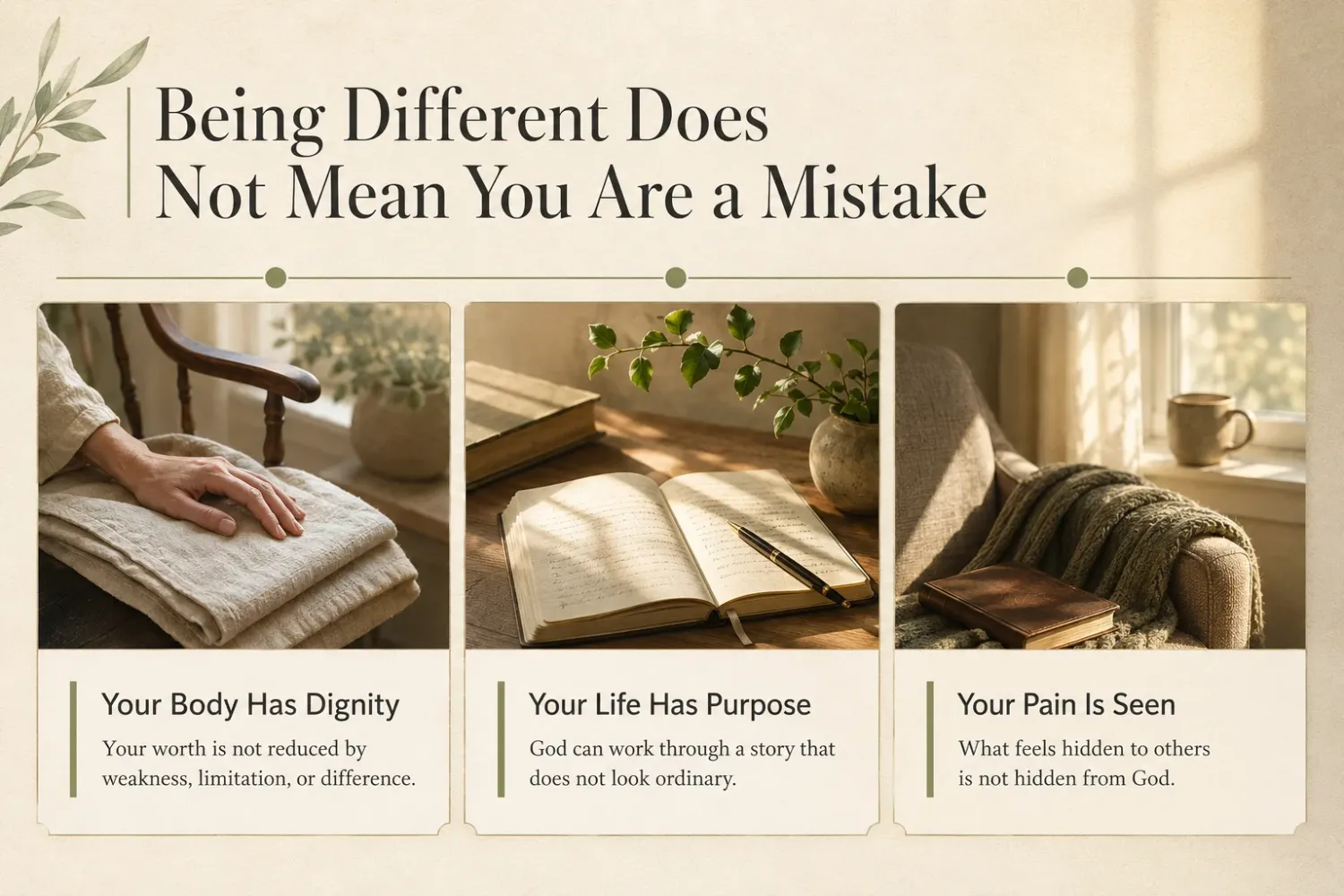
The world often measures worth by speed, strength, appearance, independence, and productivity. The kingdom of God does not. Your value is not based on how much you can do, how normal you appear, or how easy your life is for other people to understand.
You are made in the image of God. That truth comes before ability, diagnosis, appearance, pain level, social acceptance, or public opinion.
Your Body Has Dignity
Your body may carry limits. It may need help, treatment, accommodation, rest, or ongoing care. None of that removes dignity.
A Christian view of the body should never make disabled people feel like failed versions of everyone else. Your body is not outside God’s sight. Your life is not less sacred because it needs support. Jesus honored embodied people. He touched the sick, listened to the ignored, and restored people who had been pushed aside.
Dignity also means your needs should not be dismissed. Disability inclusion involves removing barriers that limit full participation, including physical, communication, and attitudinal barriers. The CDC describes disability inclusion as work that removes barriers so people with disabilities can participate fully in society. The church should care about that too.
Your Life Has Purpose
Purpose is not the same as performance. God’s purpose for your life is not limited to public ministry, visible success, or being admired for endurance.
Sometimes purpose looks like faithfulness in hidden places. Sometimes it looks like receiving care without shame. Sometimes it looks like telling the truth about pain. Sometimes it looks like showing the church how to love better, listen better, and make room for people who have been overlooked.
God can use your story, but that does not mean your disability exists only so other people can be inspired. You are not a sermon illustration. You are a person loved by God.
Your Pain Is Seen
Faith does not require pretending that disability, limitation, or difference never hurts. Some days may be heavy. You may grieve missed experiences, physical pain, social isolation, medical uncertainty, or the exhaustion of explaining yourself again and again.
God does not ask you to fake peace. The Psalms are full of honest prayers. Jesus Himself showed compassion to suffering people. You can bring grief to God without losing faith.
If feeling different has made God feel far away, you may also find comfort in what to do when you do not feel God’s love. Numbness, grief, and spiritual weariness do not mean God has left you.
What John 9 Says About Disability
John 9 is one of the most important passages for Christians asking about disability and purpose. The man was blind from birth. The disciples wanted a cause. Jesus gave a different answer.
They asked, “Who sinned?” Jesus answered, “Neither.”
That does not explain every disability in every person’s life. It does not give us permission to speak carelessly for God. It does not mean disabled people exist so others can learn lessons. It does mean Jesus rejected the idea that this man’s blindness was personal punishment.
John 9 also shows that people around the man talked about him before truly listening to him. Neighbors debated his identity. Religious leaders questioned his story. His parents were pulled into the conflict. The man had to keep answering for himself.
Many disabled Christians understand that experience. People may speak about your condition, your faith, your healing, or your future without first honoring your voice. Jesus does not erase the man. He brings him into the light.
That is part of the work of God too. Not only healing, but dignity. Not only miracle, but recognition. Not only sight restored, but a person seen.
God’s Purpose In Disability Is Not Always Simple

God’s purpose in disability is not always easy to explain. Some people are healed. Some are strengthened for a long road. Some receive new support, new community, and new courage. Some still carry questions.
We should be careful with neat answers. A simple answer may sound spiritual but leave the wounded person feeling unseen. God is sovereign, but humans should speak with humility when standing near another person’s pain.
Purpose Is Not Blame
Purpose does not mean blame. Jesus separated the man’s blindness from personal sin in John 9. That matters for anyone who has wondered, “Did I cause this?” or “Is God punishing me?”
There are times when sin has real consequences in life. But Christians should not assume a person’s disability is proof of personal sin, family sin, weak faith, or demonic bondage. Jesus warned us away from that kind of accusation in John 9.
A better response begins with compassion. Pray. Listen. Make room. Support the person. Ask what love requires.
Healing Is Not Worth
God still heals. We should not stop praying for healing. Jesus healed the sick, opened blind eyes, raised the dead, and revealed the mercy of the Father. AIIIH believes in prayer for healing because Scripture gives us reason to pray with faith.
But healing is not what gives you worth. You are not more loved after a miracle than before one. You are not less faithful if healing has not come yet. Your value is not waiting for your condition to change.
If you are wrestling with unanswered healing prayer,faith when God has not healed yet may help you hold hope without shame.
Weakness Can Show Grace
Paul prayed for his thorn in the flesh to be removed. God answered him, but not in the way Paul expected.
“My grace is sufficient for you.” - 2 Corinthians 12:9
That verse should be handled carefully. It should not be used to silence pain or deny the desire for healing. Paul asked God more than once. His prayer was real.
The USCCB note on 2 Corinthians 12 explains that Paul’s petition was denied and that grace was given in his specific situation. God’s grace did not make Paul’s weakness meaningless. Grace met him inside it.
Sometimes the work of God is healing. Sometimes the work of God is sustaining grace. Sometimes it is both over time.
How To Pray When You Feel Different
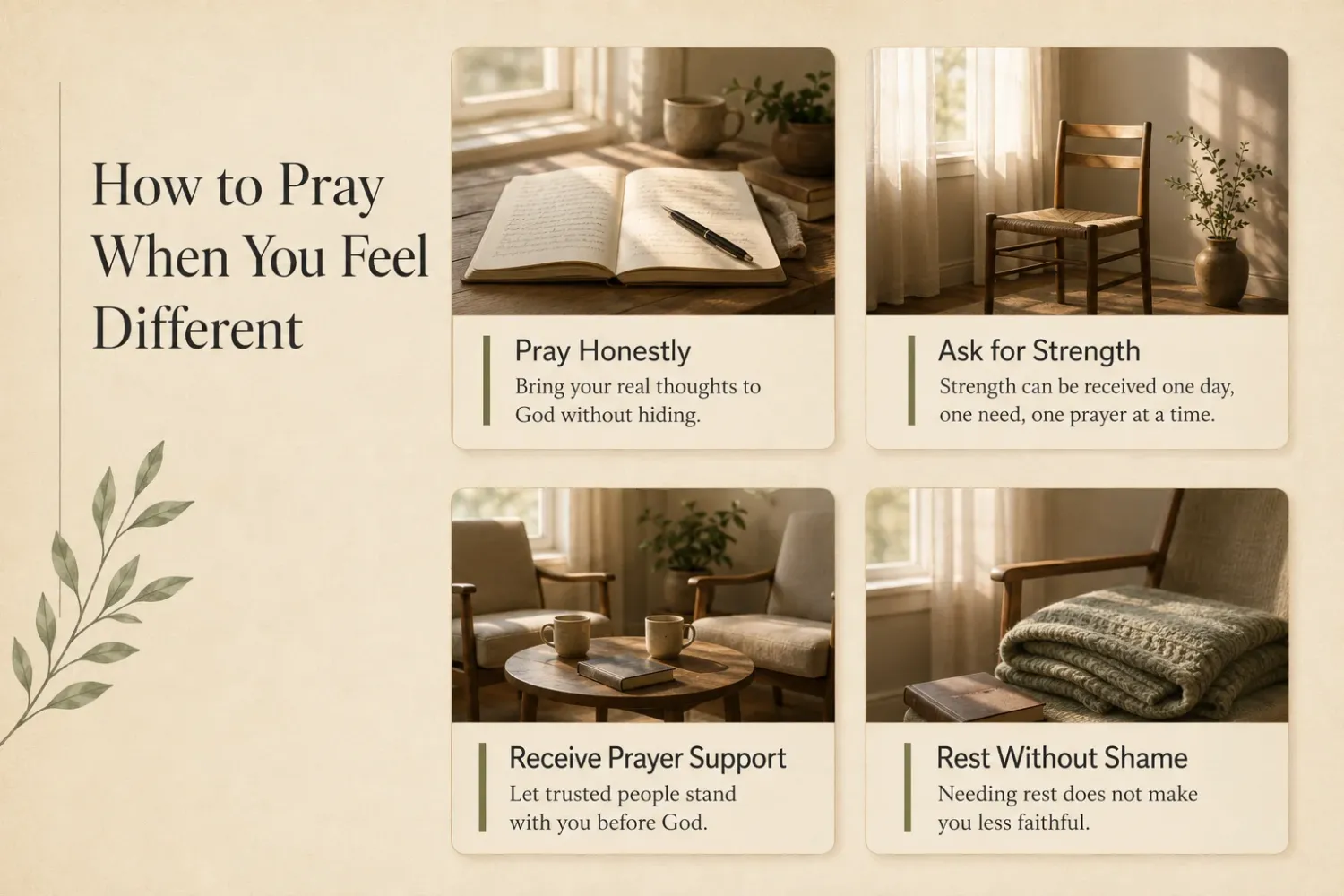
Prayer does not have to be polished. When you feel different, prayer may begin with tears, silence, confusion, or one honest sentence: “Lord, I do not understand.”
God can receive that.
Pray Honestly
Tell God what hurts. Tell Him if you feel overlooked. Tell Him if you are tired of being strong. Tell Him if you are angry, confused, or afraid.
Honest prayer is not rebellion when it is brought to God with an open heart. Many believers try to protect God from their emotions, but God is not fragile. He already knows what you carry.
You can pray, “Father, I believe You love me, but I am struggling to feel it. Help me receive Your love in the places where I feel ashamed.”
Ask For Strength
Strength does not always mean pushing harder. Sometimes strength means asking for help. Sometimes it means resting before you collapse. Sometimes it means telling the truth when people expect you to pretend.
Ask the Lord for daily grace, not just a dramatic breakthrough. Ask Him for wisdom with doctors, caregivers, family, church leaders, and friends. Ask Him for courage to receive support without feeling like a burden.
Receive Prayer Support
You do not have to carry every question alone. The body of Christ is meant to pray, comfort, include, and support one another.
Receiving prayer is not a sign of weakness. It is part of Christian life. If you are believing God for healing or need prayer, we welcome you to AIIIH’s physical healing prayer and ministry support.
You can also contact As It Is In Heaven for prayer and support if you need someone to come alongside you as you walk through this season.
Rest Without Shame
Rest can feel difficult when you already feel different. You may feel pressure to prove that you are useful, strong, or not a burden. But rest is not failure.
Jesus cared for the weary. He did not shame people for needing help. Your limits may require wisdom, pacing, boundaries, and support. That does not make you spiritually weak.
Rest can become an act of trust. It says, “God is still God when I stop.”
God Can Use Your Story Without Erasing Your Difference
Many people want God to use their story only after the hard part disappears. That is understandable. We often think testimony means the pain is over, the healing is complete, and every question has been answered.
But God can bear witness through a life that is still in process.
A Christian disability testimony does not have to sound like, “I suffered, then God fixed everything.” Sometimes it sounds like, “I still have limits, but God has not left me.” Sometimes it sounds like, “I still need help, and I am still loved.” Sometimes it sounds like, “My body is different, but Christ is near.”
God can use your story without making your disability the whole story. He can use your compassion, prayers, wisdom, endurance, creativity, honesty, and love. He can use your voice to help the church become more faithful. He can use your life to remind others that the body of Christ needs every member.
If suffering has made you ask whether God cares, hope when life hurts may help you stay honest before God while still holding onto His heart.
FAQs
Did God make me disabled?
Did God make me disabled is a question that deserves care. God is your Creator, and your life has dignity, but Scripture does not give a simple explanation for every disability. John 9 shows Jesus rejecting the idea that one man’s blindness was caused by personal sin.
Is disability caused by sin?
Disability is not always caused by personal sin. In John 9, Jesus clearly said the man’s blindness was not because he or his parents sinned. We live in a fallen world, but Christians should not blame disabled people for their condition.
Does God still heal disabilities?
God still heals, and Christians can pray for healing with faith. At the same time, lack of immediate healing does not mean lack of faith or lack of worth. God may work through healing, sustained grace, medical care, community, and daily strength.
Can God use my disability?
God can use your disability, but you are not only useful because of your disability. He can use your whole life, including your faith, wisdom, compassion, endurance, gifts, and testimony. Your story matters without turning your pain into a performance.
SUPPORT THIS MINISTRY
As a Catholic nonprofit, every dollar given is prayerfully used to build the Kingdom of God — on earth as it is in heaven. Through your generosity, we are able to continue proclaiming the Gospel, setting the captives free, and equipping the Body of Christ to walk in healing, deliverance, and true freedom. Your gift is not just a donation; it is an act of faith that multiplies into souls restored, families healed, and lives transformed by the power of Jesus Christ. We keep nothing for ourselves. All contributions go directly toward sustaining this ministry — providing the tools, technology, staff, and outreach necessary to reach more hearts with the mercy of God. Please prayerfully consider sowing into this mission. Together, we are answering Christ’s call to heal the brokenhearted, proclaim liberty to captives, and set free those who are oppressed.