
Why Won’t God Heal Me? Faith When Healing Has Not Come

Written by: Christopher Gomez
Table of Contents
When you have prayed for healing and nothing seems to change, the question can feel too heavy to say out loud: why won’t God heal me?
You may believe God can heal. You may have seen Him heal others. You may have prayed, fasted, cried, asked for prayer, confessed sin, and tried to keep your faith alive. Yet the pain remains. The diagnosis remains. The weakness remains. The unanswered prayer remains.
That kind of suffering can make a believer feel confused, forgotten, or even ashamed. Some people wonder if God is angry with them. Others wonder if they did not have enough faith. Some feel guilty for being disappointed with God, so they hide their grief behind spiritual words they do not really feel.
But Scripture does not treat suffering lightly. Jesus had deep compassion for the sick. The Psalms give language to grief and confusion. Paul prayed for relief and still carried weakness. Job suffered without being given a simple explanation.
Unanswered healing prayers do not prove that God has abandoned you. They do not prove that your faith is fake. They do not mean your pain is invisible to heaven. They do mean you need truth, tenderness, and a faithful way to keep walking with God while healing has not yet come.
Key Takeaways
God can heal, but Scripture does not promise every believer immediate physical healing.
Unanswered healing prayers do not prove weak faith, hidden sin, or God’s rejection.
Honest grief, anger, and confusion can be brought to God without shame.
Prayer for healing can continue alongside medical care, wise counsel, and community support.
Why Does God Heal Some People and Not Others?
This is one of the hardest questions a Christian can ask. It becomes even harder when the question is not theoretical. It is your body, your pain, your family member, your diagnosis, or your long season of waiting.
The Bible shows that God heals. Jesus healed the blind, the lame, the leper, the bleeding woman, and many others who came to Him in need. Healing was not a side issue in His ministry. It revealed His compassion, His authority, and the coming kingdom of God.
At the same time, Scripture does not give us a simple formula that explains every case of suffering. Some people were healed instantly. Some waited. Some faithful people still suffered. Paul told Timothy to use wine for his stomach and frequent illnesses. Paul also left Trophimus sick in Miletus. These details matter because they show that sickness in a believer’s life does not automatically mean spiritual failure.
God is not less loving when we do not understand His timing. But love does not always answer in the way we expect. Sometimes God heals physically. Sometimes He strengthens the person who is still suffering. Sometimes He works through doctors, treatment, rest, time, repentance, forgiveness, inner healing, deliverance, community, or endurance.
That does not make the pain easy. It simply keeps us from giving shallow answers where Scripture gives holy mystery.
What the Bible Shows About Healing
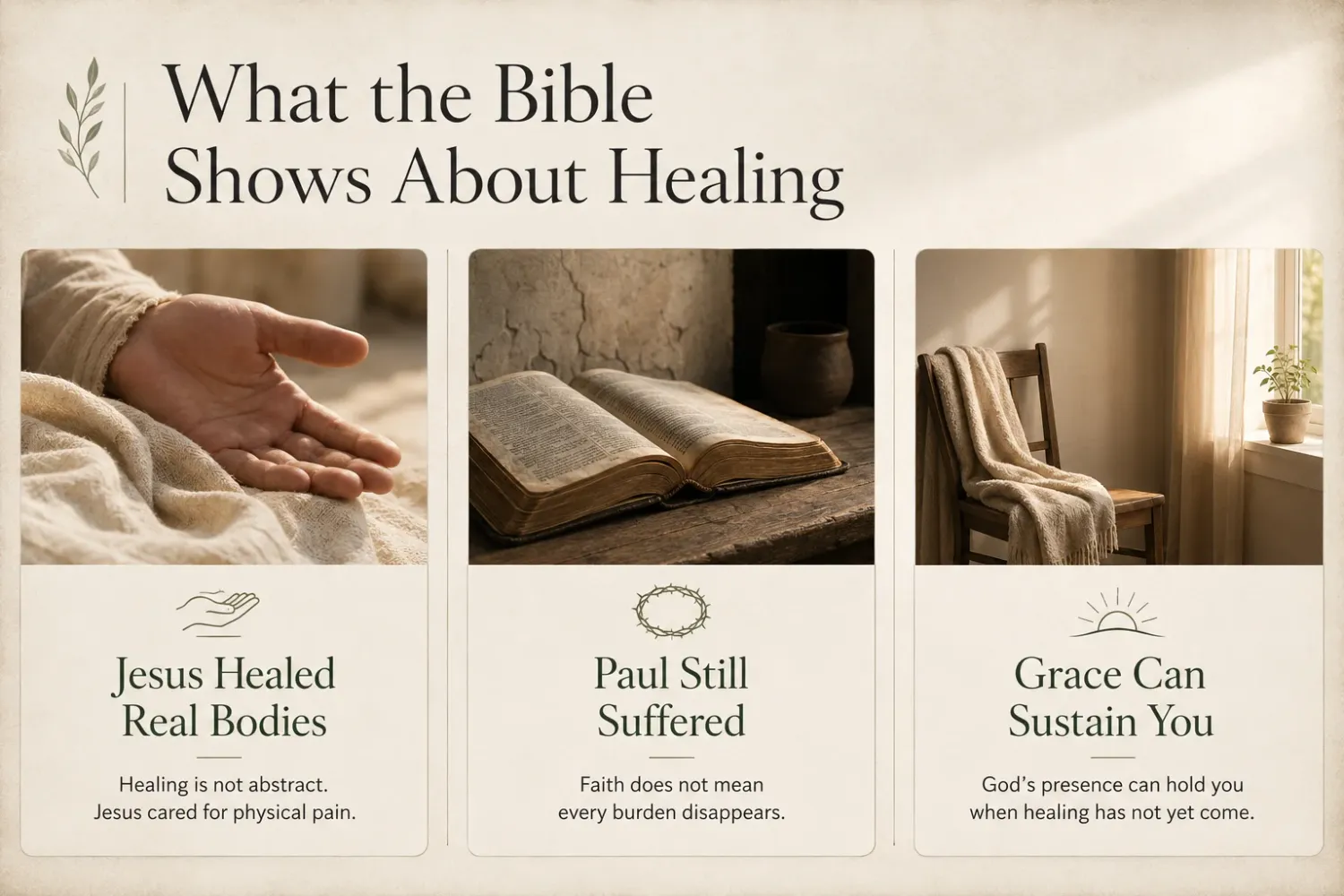
The Bible gives us more than one picture of healing. It shows miracles, compassion, waiting, weakness, endurance, and hope. Holding those together helps us avoid two dangerous extremes.
One extreme says God no longer heals, so we should not expect Him to move. The other says God must heal every person immediately if they have enough faith. Neither view carries the full weight of Scripture.
Jesus Healed Real Bodies
Jesus did not treat sickness as imaginary or unimportant. He touched lepers. He listened to desperate cries. He restored bodies, dignity, family connection, and worship access.
“And Jesus went about all Galilee, teaching in their synagogues, and preaching the gospel of the kingdom, and healing all manner of sickness.” - Matthew 4:23
This matters because physical healing is not beneath God. Your body matters to Him. Your pain matters to Him. Christianity is not a faith that tells people to pretend suffering is fine.
When you pray for healing, you are not asking for something strange or unbiblical. You are coming to a compassionate Savior who has power over sickness and deep mercy for the hurting.
Paul Still Suffered
Paul loved Jesus. Paul preached the gospel. Paul saw miracles. Yet Paul also carried a “thorn in the flesh” and pleaded with the Lord to take it away.
“My grace is sufficient for thee: for my strength is made perfect in weakness.” - 2 Corinthians 12:9
Paul’s story is not a reason to stop praying for healing. He did pray. He asked repeatedly. But when the answer was not removal, God gave sustaining grace.
That grace was not a cold replacement for healing. It was the presence and strength of Christ meeting Paul inside weakness. Paul’s suffering did not mean God was absent. It became a place where Christ’s power held him.
Grace Can Sustain You
Grace does not always mean the pain disappears. Sometimes grace means God gives enough strength for today, enough light for the next step, and enough hope to keep your heart from collapsing.
This kind of grace may look small from the outside. It may come through Scripture that keeps you anchored. It may come through a friend who prays when you cannot. It may come through a doctor who finds the right treatment. It may come through quiet endurance when you expected yourself to give up.
Sustaining grace is not the same as pretending you are healed. It is God meeting you truthfully in the place where healing has not yet come.
Does Unanswered Healing Mean Weak Faith?
No, unanswered healing does not automatically mean weak faith.
That answer needs to be clear because many wounded believers have been hurt by careless spiritual advice. Some have been told that if they were still sick, they must not have believed enough. Others have been told they must have hidden sin, secret bitterness, demonic bondage, or disobedience.
Sin, spiritual oppression, bitterness, stress, trauma, and practical choices can affect a person’s life. There are times when repentance, deliverance, forgiveness, wise counsel, or deeper spiritual care may be needed. But Scripture does not allow us to say every sickness is caused by the same thing.
In John 9, Jesus’ disciples saw a man born blind and asked whose sin caused it. Jesus did not accept their assumption.
“Neither hath this man sinned, nor his parents: but that the works of God should be made manifest in him.” - John 9:3
That answer should make us careful. Not every illness is a punishment. Not every delay is a rebuke. Not every unanswered prayer is proof that the person failed.
Faith is not measured only by whether the outcome changes immediately. Sometimes faith looks like asking again. Sometimes faith looks like crying before God without walking away. Sometimes faith looks like taking medicine, going to treatment, asking for prayer, and still saying, “Lord, I need You.”
What if I Feel Angry at God?

Many Christians are afraid to admit anger toward God. They think honesty will dishonor Him. So they bury frustration under religious language. But buried anger often turns into distance, numbness, or quiet bitterness.
God is not threatened by honest grief. He already knows what is in your heart. The question is not whether you have pain. The question is where you bring it.
Bring God Your Honesty
The Psalms are filled with honest prayer. David and other psalmists asked why God seemed far away, why suffering continued, and how long they would have to wait.
“How long wilt thou forget me, O LORD? for ever? how long wilt thou hide thy face from me?” - Psalm 13:1
That is not polite denial. It is faithful lament. Lament is not unbelief. Lament is pain brought into relationship with God.
You can tell God the truth. You can say, “I do not understand.” You can say, “I feel forgotten.” You can say, “I am tired of praying the same prayer.” Honest prayer is often the beginning of deeper healing because it stops pretending and starts bringing the real wound into God’s presence.
Grieve Without Shame
Grief is not rebellion. Jesus wept at Lazarus’ tomb even though He knew resurrection was coming. That moment shows us something tender about the heart of God. Hope does not erase sorrow. Faith does not require emotional numbness.
If you are grieving the life you expected, the body you used to have, the energy you lost, or the prayers that still feel unanswered, that grief is real. You do not have to minimize it to prove you trust God.
Healthy grief makes room for both sorrow and faith. It says, “Lord, this hurts, and I still need You.”
Refuse Bitter Isolation
Anger becomes dangerous when it hardens into isolation. Pain often tells you to pull away from prayer, Scripture, church, and people who love you. Sometimes you may need quiet. Sometimes you may need space from shallow voices. But isolation should not become your home.
Let trusted believers pray with you. Find people who can sit with pain without rushing to fix it. Ask God for community that is gentle, wise, and spiritually grounded.
You do not need people who shame you for suffering. You need people who can help carry you toward Jesus.
How to Keep Faith During Chronic Illness
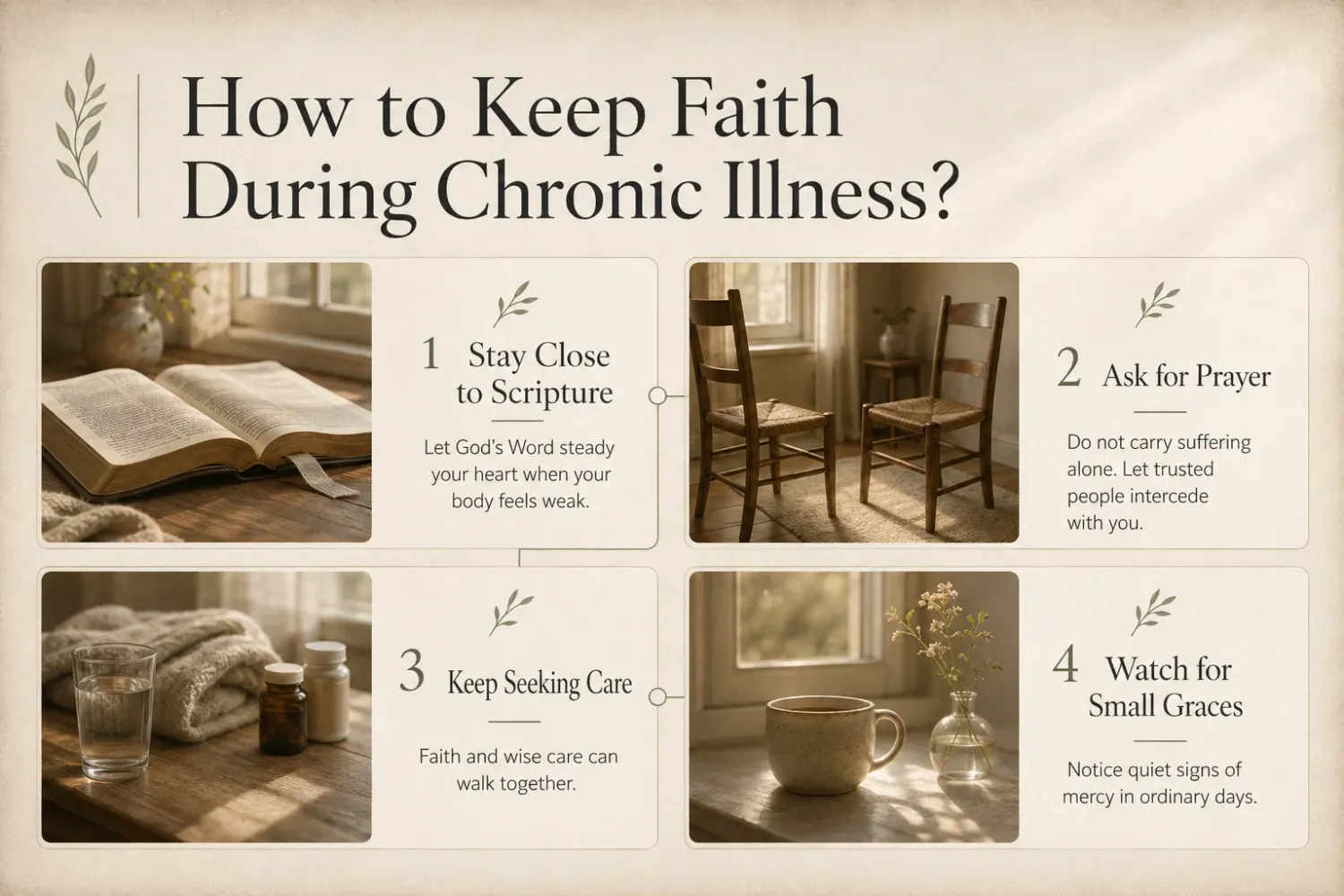
Christian chronic illness can bring a unique kind of weariness. It is not only the pain itself. It is the repetition. The appointments. The fatigue. The prayers that feel familiar. The gap between what you believe God can do and what you are still living with.
Keeping faith during chronic illness does not mean acting strong every day. It means staying connected to God in honest, sustainable ways.
Stay Close to Scripture
When your emotions are exhausted, Scripture can anchor you. That does not mean every verse will feel comforting right away. Some days you may only have strength for one Psalm, one Gospel story, or one short promise.
Choose passages that show both God’s power and His nearness to the broken. Read the healing stories of Jesus. Read the lament Psalms. Read 2 Corinthians 12. Read Romans 8, where creation groans and hope remains.
Do not use Scripture as a weapon against your own heart. Use it as daily bread.
Ask for Prayer
Asking for prayer is not weakness. James 5 encourages believers to pray for the sick. The church is meant to be a praying community, not a place where suffering people have to hide.
You may need different kinds of prayer in different seasons. Sometimes you need prayer for physical healing. Sometimes you need prayer for endurance, wisdom, peace, provision, or emotional healing. Sometimes you need others to pray because you feel too tired to form the words.
Let people help you carry what has become too heavy to carry alone.
Keep Seeking Care
Prayer for healing should not replace professional medical care. Doctors, treatment, therapy, medication, nutrition, rest, and practical support can all be part of God’s mercy.
Seeking medical help is not a lack of faith. Luke was called a physician. Paul gave Timothy practical advice for his stomach and frequent illnesses. God can heal through a miracle, and He can also work through wise care.
If you are dealing with ongoing symptoms, emotional distress, or thoughts of harming yourself, seek immediate professional help and tell someone you trust. Spiritual support matters, but it should not replace urgent medical or mental health care when safety is at risk.
Watch for Small Graces
Long suffering can make every day feel like evidence that nothing is changing. But God often gives small graces along the way.
A slightly better day. A kind message. A moment of peace. A doctor who listens. A verse that meets you. A worship song that helps you breathe again. A friend who stays.
Small graces do not erase the need for healing. They remind you that God is still present while you wait.
When God Has Not Healed You Yet
The word “yet” can be painful. It holds hope, but it also admits the ache of waiting.
When God has not healed you yet, you can keep praying without pretending. You can ask boldly and still surrender honestly. You can believe in miracles and still go to the doctor. You can desire physical healing and also ask God for inner healing, spiritual freedom, endurance, and grace.
Jesus Himself prayed in Gethsemane with anguish. He asked the Father if the cup could pass from Him, yet He surrendered to the Father’s will. That does not make suffering simple. It shows that surrendered prayer can include deep distress.
“O my Father, if it be possible, let this cup pass from me: nevertheless not as I will, but as thou wilt.” - Matthew 26:39
You are allowed to ask for the cup to pass. You are allowed to ask for healing again. You are allowed to say the waiting hurts. And with God’s help, you can also pray, “Hold me close if the answer does not come the way I hope.”
Here is a simple prayer you can make your own:
Lord Jesus, I believe You are compassionate and able to heal. I bring You my body, my pain, my questions, and my disappointment. Please heal what is broken, strengthen what is weak, and comfort what is grieving. Help me not to confuse waiting with rejection. Give me wisdom for the care I need, courage to ask for prayer, and grace to keep trusting You today. Amen.
Hope When Healing Has Not Come Yet
When you are asking, “why won’t God heal me,” you do not need a shallow answer. You need the presence of Christ, the truth of Scripture, and people who can pray with compassion and wisdom.
God has not forgotten you. Your pain is not proof that He has turned away. Your unanswered healing prayers do not make you a failed Christian. You can keep bringing your body, your grief, your anger, your questions, and your hope to the Lord.
Healing may come suddenly. Healing may come gradually. Healing may come through medical care, inner restoration, spiritual freedom, endurance, or the final healing promised in the resurrection. Until then, God’s grace is not distant from your weakness. Christ meets you there.
If you need prayer or pastoral support as you walk through this season, we welcome you to connect with our ministry and join our monthly healing call, held on the first Tuesday of every month.
FAQs
Why hasn’t God healed me yet?
God may not have healed you yet for reasons you cannot fully see right now. Scripture shows that God can heal instantly, but it also shows faithful people who suffered while still being loved by Him. Unanswered healing does not mean God has rejected you.
Does God heal everyone who asks?
God does not heal everyone immediately in this life, even though He is able to heal. Christians can still pray boldly for healing while trusting God with the timing, method, and outcome.
Is sickness a sign of sin?
Sickness is not always a sign of sin. Some suffering may be connected to choices, spiritual issues, or brokenness in the world, but Jesus warned against assuming every illness is caused by personal sin. Use wisdom, prayer, and discernment instead of shame.
Should I keep praying for healing?
Yes, you can keep praying for healing. Ask God honestly and boldly, but do not carry pressure to perform or prove your faith. Keep praying while also seeking medical care, wise counsel, and supportive Christian community.
Can I be angry at God?
You can bring anger, grief, and disappointment to God honestly. The Bible gives language for lament, especially in the Psalms. The goal is not to hide your anger, but to bring it into God’s presence before it hardens into bitterness.
Should Christians seek medical help while praying for healing?
Christians should seek medical help while praying for healing when care is needed. Prayer and medical care do not have to compete. God can work through miracles, treatment, doctors, rest, and wise support.
SUPPORT THIS MINISTRY
As a Catholic nonprofit, every dollar given is prayerfully used to build the Kingdom of God — on earth as it is in heaven. Through your generosity, we are able to continue proclaiming the Gospel, setting the captives free, and equipping the Body of Christ to walk in healing, deliverance, and true freedom. Your gift is not just a donation; it is an act of faith that multiplies into souls restored, families healed, and lives transformed by the power of Jesus Christ. We keep nothing for ourselves. All contributions go directly toward sustaining this ministry — providing the tools, technology, staff, and outreach necessary to reach more hearts with the mercy of God. Please prayerfully consider sowing into this mission. Together, we are answering Christ’s call to heal the brokenhearted, proclaim liberty to captives, and set free those who are oppressed.