
Does God Care About Me When I’m Suffering?

Written by: Christopher Gomez
Table of Contents
Yes, God cares about you, even when life hurts and even when you cannot feel His nearness. Suffering can make God feel silent, distant, or unmoved, but pain is not proof that He has left you.
Many believers quietly carry the fear, “God doesn’t care about me.” That fear often grows when prayers seem unanswered, people misunderstand your pain, or the same burden keeps returning. If that is where you are, you are not weak, dramatic, or faithless. You are hurting.
Scripture does not shame people for crying out to God. Psalm 13 begins with the honest question, “How long, O LORD?” God gave His people language for grief because He knew there would be seasons when faith feels costly. The goal is not to pretend you are fine. The goal is to bring your real pain to the Father who sees you.
Key Takeaways
Suffering does not mean God has stopped caring about you.
The Bible gives room for honest pain, waiting, and unanswered questions.
God may help through prayer, Scripture, community, ministry, counseling, or medical care.
Fear, anxiety, and OCD should be handled with compassion, not shame.
Does God Care About Me Even When Life Hurts?
God’s care is not measured by how easy your life feels right now. If ease were the only sign of God’s love, many faithful people in Scripture would have looked abandoned. David wept. Job grieved. Elijah felt alone. Paul pleaded for relief. Jesus Himself suffered.
The Christian answer to “does God care about me?” is not a shallow “yes” that ignores your pain. It is a deeper yes rooted in the character of God and the suffering of Christ. God did not stay far away from human sorrow. In Jesus, He entered it.
“The LORD is close to the brokenhearted and saves those who are crushed in spirit.” - Psalm 34:18
That verse does not say the brokenhearted always feel close to God. It says the Lord is close to them. Your feelings may be exhausted, but His nearness is not dependent on your emotional strength.
When you are suffering, the enemy may try to turn pain into accusation: “God forgot you. God is punishing you. God helps other people, but not you.” Those thoughts may feel convincing when you are tired, but they are not the full truth. Suffering can cloud your view of God, but it does not change His heart.
If you are also wrestling with the feeling that God’s love has disappeared, our teaching on not feeling God’s love may help you name that struggle without shame.
Why It Can Feel Like God Doesn’t Care
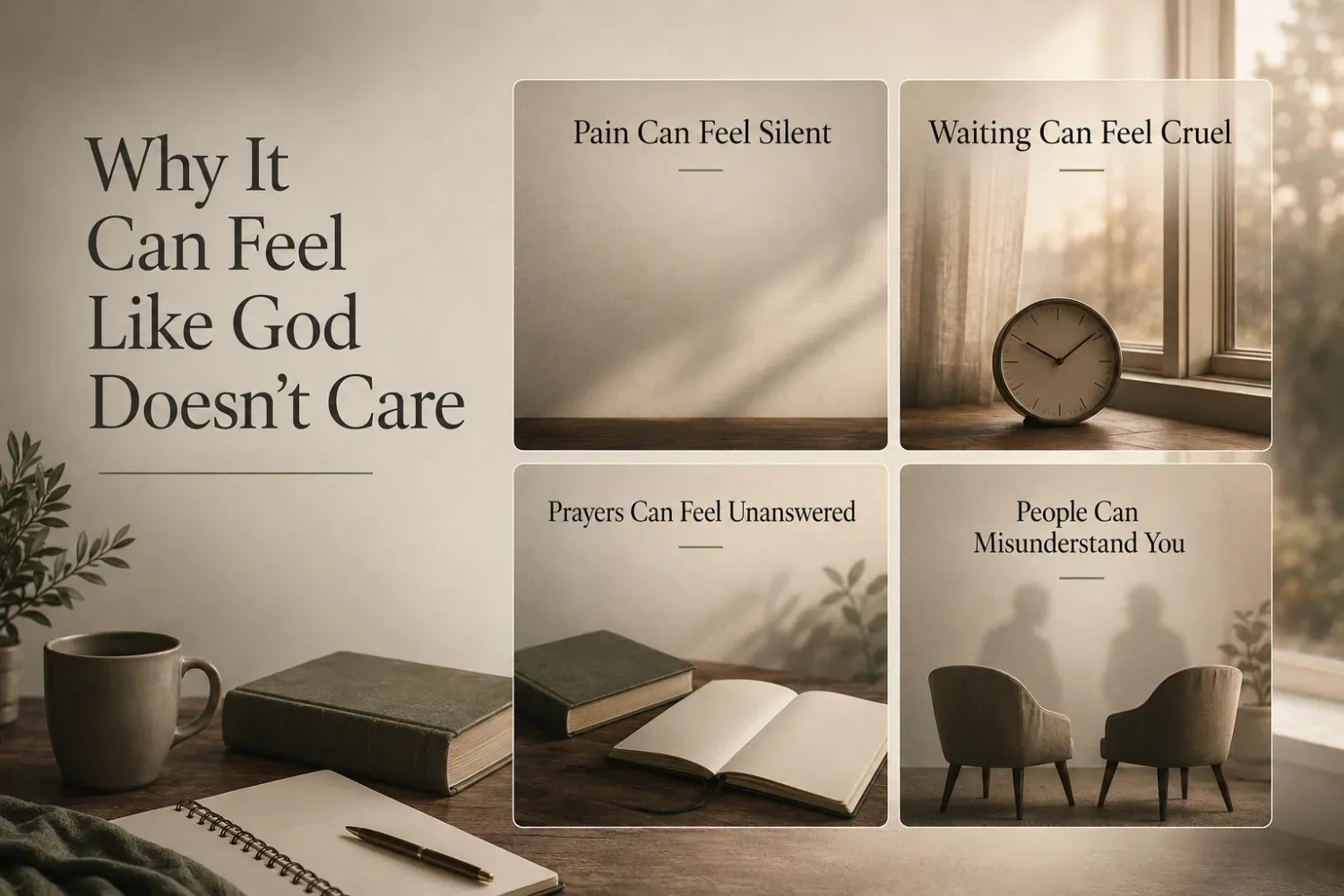
There are real reasons suffering can make God feel far away. Naming them can help you stop condemning yourself for the pain you feel.
Pain Can Feel Silent
Pain often narrows your world. When you are grieving, sick, anxious, or spiritually tired, it can feel like all you hear is the sound of your own distress. You may pray, read Scripture, and still feel numb.
Silence is hard because we often expect love to feel obvious. But God’s care is not always loud. Sometimes His care holds you together quietly when you do not have the strength to hold yourself.
Waiting Can Feel Cruel
Waiting is one of the hardest parts of faith. It can feel especially cruel when you are waiting for healing, provision, reconciliation, or relief from fear.
The Bible does not treat waiting as easy. Many psalms are prayers from people who are still waiting. They do not always end with immediate answers, but they do show that waiting believers are still allowed to pray honestly.
Prayers Can Feel Unanswered
Unanswered prayer can feel personal. You may wonder, “Why doesn’t God help me when I am begging Him?” That question deserves more than a quick answer.
Sometimes God answers differently than we expect. Sometimes He gives strength before relief. Sometimes He brings help through people, treatment, counsel, or ministry. Sometimes we do not understand the timing at all. What we must not do is assume that delayed relief means God is indifferent.
If your pain is tied to healing that has not come yet, you may also find comfort in faith when healing has not come.
People Can Misunderstand You
Suffering becomes heavier when people minimize it. You may hear phrases that sound spiritual but leave you feeling more alone, such as “just have more faith” or “everything happens for a reason.”
Not every person will know how to sit with pain well. That does not mean your pain is too much for God. Jesus is not impatient with the wounded. He is gentle with those who come to Him honestly.
What the Bible Says About God and Suffering

The Bible does not give a simple formula for every painful situation. It gives us something better: a true picture of God’s heart in the middle of suffering.
God Sees Your Pain
God does not overlook private tears. Psalm 56:8 pictures God as One who knows the wanderings and tears of His people. The point is not that every tear feels meaningful in the moment. The point is that no tear is hidden from Him.
You may feel unseen by people. You may feel misunderstood in your family, church, or friendships. But God is not confused about what you are carrying.
Jesus Understands Suffering
Jesus is not a distant Savior giving advice from a safe place. He knew grief, rejection, betrayal, physical suffering, and loneliness. Hebrews 4:15 says He is able to sympathize with our weaknesses.
That matters because when you pray in pain, you are not praying to a God who lacks compassion. Jesus understands human suffering from the inside. He knows what it is to cry out, to endure, and to trust the Father when the path is painful.
The Spirit Helps You Pray
Romans 8 says the Spirit helps us in our weakness. That is good news when you do not know what to say.
“The Spirit himself intercedes for us through wordless groans.” - Romans 8:26
There may be days when your prayer is only, “Lord, help me.” That is still prayer. There may be days when you sit silently before God because words feel impossible. The Spirit is not intimidated by weakness.
Suffering Is Not Abandonment
Suffering is painful, but it is not proof that God has abandoned you. Romans 8 speaks honestly about groaning, weakness, and waiting, but it also declares that nothing can separate God’s people from His love.
That does not erase the pain. It gives pain a boundary. Suffering may be loud, but it does not have the final word over God’s care for you.
Why Doesn’t God Help Me Right Away?
God’s timing can be one of the hardest parts of trusting Him. When you are suffering, “not yet” can feel like “no,” and silence can feel like rejection.
There is no honest way to explain every delay. Some suffering remains mysterious. Some prayers are answered slowly. Some answers come through ordinary means that do not feel miraculous at first. God’s help may come through a doctor, a counselor, a pastor, a trusted friend, a deliverance session, a healing prayer meeting, or a renewed strength to endure one more day.
We should be careful not to reduce every struggle to one cause. Some pain is spiritual. Some pain is emotional. Some pain is physical. Some pain is relational. Often, several things are happening at once. Wisdom receives support without guilt.
If you need prayer for healing, AIIIH offers physical healing prayer for those believing God for help in their bodies. Seeking prayer does not mean refusing practical care. God can work through both.
When Fear, Anxiety, or OCD Makes God Feel Far Away
Some believers feel far from God because fear keeps accusing them. They may worry they have sinned too much, prayed wrongly, lost salvation, offended God, or failed spiritually because intrusive thoughts keep coming.
Christian OCD support matters here, especially when scrupulosity is involved. Scrupulosity is often described as OCD centered on religious or moral fears. The International OCD Foundation explains that OCD can involve unwanted intrusive thoughts and compulsions, and that scrupulosity can focus on religious or moral concerns. If that sounds familiar, it may help to read more about religious OCD and scrupulosity.
Intrusive thoughts are not the same as chosen beliefs. Fearful thoughts about God do not automatically mean you are rebellious, condemned, or spiritually failing. A tender conscience can become exhausted when anxiety keeps demanding certainty.
Prayer is still good. Scripture is still good. But if prayer becomes a compulsion that you repeat for hours to relieve panic, or if confession becomes a cycle you cannot stop, wise support is needed. A pastor who understands grace and a licensed mental health professional who understands OCD can both be part of care. Mayo Clinic notes that OCD treatment often includes psychotherapy, medicine, or both, depending on the person’s needs.
If your distress includes thoughts of self-harm, or you feel like you may not be safe, seek immediate help. In the United States, the 988 Suicide & Crisis Lifeline offers crisis support. Outside the United States,Find a Helpline can help you locate support in your country.
How to Hold Onto God While You’re Suffering
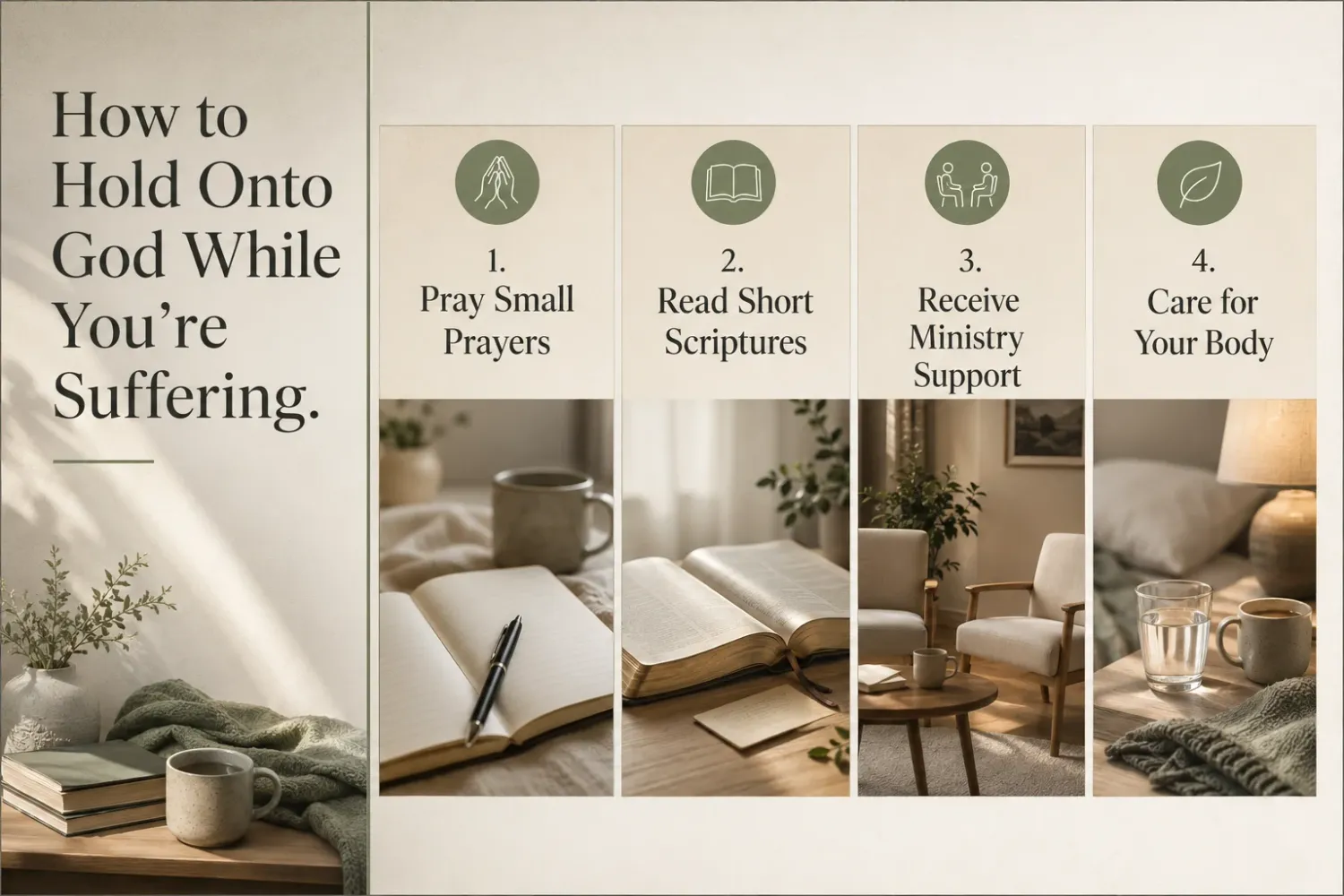
Holding onto God in suffering does not mean acting strong. It means taking small faithful steps when your heart feels weak.
Pray Small Prayers
You do not need polished words. Start with simple prayers:
“Lord, I need You.”
“Jesus, help me trust You today.”
“Father, I feel forgotten. Please meet me here.”
“Holy Spirit, pray in me when I do not know what to say.”
Small prayers are not small to God. They are honest openings of the heart.
Read Short Scriptures
When you are overwhelmed, long reading plans may feel impossible. Choose short passages and stay with them slowly. Psalm 13, Psalm 34:18, Romans 8:26-39, Hebrews 4:15-16, and 1 Peter 5:7 are good places to begin.
“Casting all your anxiety on him, because he cares for you.” - 1 Peter 5:7
Do not rush past that sentence. God does not ask you to carry anxiety alone. He invites you to bring it to Him because He cares.
Receive Ministry Support
Pain often grows darker in isolation. You may need someone to pray with you, listen without rushing you, and help you discern what kind of support is needed.
AIIIH offers one-on-one deliverance sessions for those seeking prayer, healing, and freedom in Christ. Not every painful season is a deliverance issue, but ministry support can be helpful when you feel spiritually oppressed, stuck, afraid, or deeply burdened.
You can also contact As It Is In Heaven if you need prayer or guidance on the next step.
Care for Your Body
Suffering affects the whole person. Sleep, food, movement, medical care, and safe relationships matter. Caring for your body is not a lack of faith.
If anxiety, depression, OCD, trauma, or chronic illness is involved, do not treat professional care as failure. God can use wise doctors, therapists, counselors, and pastors as part of His mercy. Prayer and practical care do not need to compete.
How People-Pleasing Damages Relationships and Faith
God still cares about you when you cry. He still cares when you feel numb. He still cares when your prayers sound small. He still cares when you are tired of waiting.
Your suffering may be real, but it is not the final definition of your life. Your unanswered questions may be honest, but they are not stronger than the love of God in Christ. Bring Him the pain you actually have, not the version you think a stronger Christian should have.
A simple prayer may be enough for today:
Father, I feel tired, unseen, and confused. Please meet me in this pain. Help me believe You care, even when I cannot feel it. Give me wisdom, support, and strength for the next step. Hold me close to Jesus, and teach me how to trust You one day at a time. Amen.
If you need prayer or pastoral support as you walk through this season, we welcome you to connect with our ministry and join our monthly healing call, held on the first Tuesday of every month.
FAQs
Does God care when I cry?
Yes, God cares when you cry. Scripture shows that God is close to the brokenhearted, and Jesus showed deep compassion toward people in pain. Your tears do not push Him away.
Why does God feel silent?
God may feel silent when grief, fear, waiting, or exhaustion makes it hard to sense His presence. Silence does not always mean absence. Keep praying honestly, and seek support from trusted believers when the silence feels heavy.
Does suffering mean God is punishing me?
Suffering does not automatically mean God is punishing you. The Bible shows many reasons people suffer, including life in a broken world. Avoid assuming guilt where God has not convicted you, and bring your questions to Him with honesty.
Can Christians struggle with OCD?
Yes, Christians can struggle with OCD. Intrusive thoughts, compulsions, and scrupulosity are not signs that someone is spiritually hopeless. Prayer, pastoral care, and qualified mental health support can work together.
What should I pray when I feel forgotten?
When you feel forgotten, pray simply: “Lord, I feel unseen, but I choose to bring You my pain. Help me know You are near. Give me strength for today.” Honest prayer is better than pretending you are fine.
SUPPORT THIS MINISTRY
As a Catholic nonprofit, every dollar given is prayerfully used to build the Kingdom of God — on earth as it is in heaven. Through your generosity, we are able to continue proclaiming the Gospel, setting the captives free, and equipping the Body of Christ to walk in healing, deliverance, and true freedom. Your gift is not just a donation; it is an act of faith that multiplies into souls restored, families healed, and lives transformed by the power of Jesus Christ. We keep nothing for ourselves. All contributions go directly toward sustaining this ministry — providing the tools, technology, staff, and outreach necessary to reach more hearts with the mercy of God. Please prayerfully consider sowing into this mission. Together, we are answering Christ’s call to heal the brokenhearted, proclaim liberty to captives, and set free those who are oppressed.