
Am I a Spiritually Immature Christian? Signs and Next Steps

Written by: Christopher Gomez
Table of Contents
A spiritually immature Christian is not a hopeless Christian. It often means there are areas where faith has not yet grown into steady obedience, humility, love, truth, and discernment.
Many believers know Christian words, attend church, pray, or serve, yet still react from pride, fear, selfishness, dishonesty, or wounded places. That does not mean God is finished with them. It means the Holy Spirit is inviting them into deeper growth.
Spiritual immaturity should be handled with truth, not shame. Conviction leads us back to God. Condemnation makes us hide. The Lord corrects His children because He loves them, and His correction is meant to restore, not destroy.
Key Takeaways
Spiritual immaturity is often seen in reactions, relationships, honesty, and discernment.
Childlike faith trusts God, but childish faith avoids growth, correction, and responsibility.
Some immature patterns may be tied to wounds, fear, lies, or spiritual bondage, but not every weakness is demonic.
Growing in spiritual maturity begins with humility, truth, empathy, Scripture, prayer, and wise support.
What Is a Spiritually Immature Christian?
A spiritually immature Christian is a believer whose character has not yet caught up with their confession. They may truly love God, but still respond to life in ways shaped by the flesh more than the Spirit.
Paul spoke to the Corinthian church this way:
“And I, brethren, could not speak unto you as unto spiritual, but as unto carnal, even as unto babes in Christ.” - 1 Corinthians 3:1
Paul was not saying they were beyond hope. He was showing them that envy, strife, division, and fleshly reactions were signs that they still needed to grow.
Spiritual immaturity can show up through defensiveness, shallow love, weak self-control, jealousy, harsh speech, poor discernment, and refusal to admit wrong. A person may have Bible knowledge and still lack Christlike character. Knowledge matters, but maturity is shown in how truth shapes the heart.
A spiritually mature believer is not perfect. Maturity does not mean you never struggle. It means you are learning to repent faster, love deeper, listen better, forgive more honestly, and obey God even when your emotions resist.
Childlike Faith Is Not Childish Faith
Jesus honored childlike faith. He did not honor childish rebellion.
Childlike faith is humble, trusting, dependent, and open to God. It receives the Kingdom with wonder. It does not need to control everything before obeying.
Childish faith is different. Childish faith refuses correction, avoids responsibility, resists deeper truth, and expects others to carry what God is calling the person to face.
Jesus said:
“Except ye be converted, and become as little children, ye shall not enter into the kingdom of heaven.” - Matthew 18:3
That verse calls us to humility, not immaturity. A childlike heart trusts the Father. A childish heart resists growth when trust becomes costly.
Paul gives another picture of maturity inEphesians 4:14-16 on growing up in Christ. He connects maturity with stability, truth, love, and the body of Christ being built up together. Mature faith becomes less easily shaken, less easily deceived, and more rooted in love.
Signs You May Be Spiritually Immature
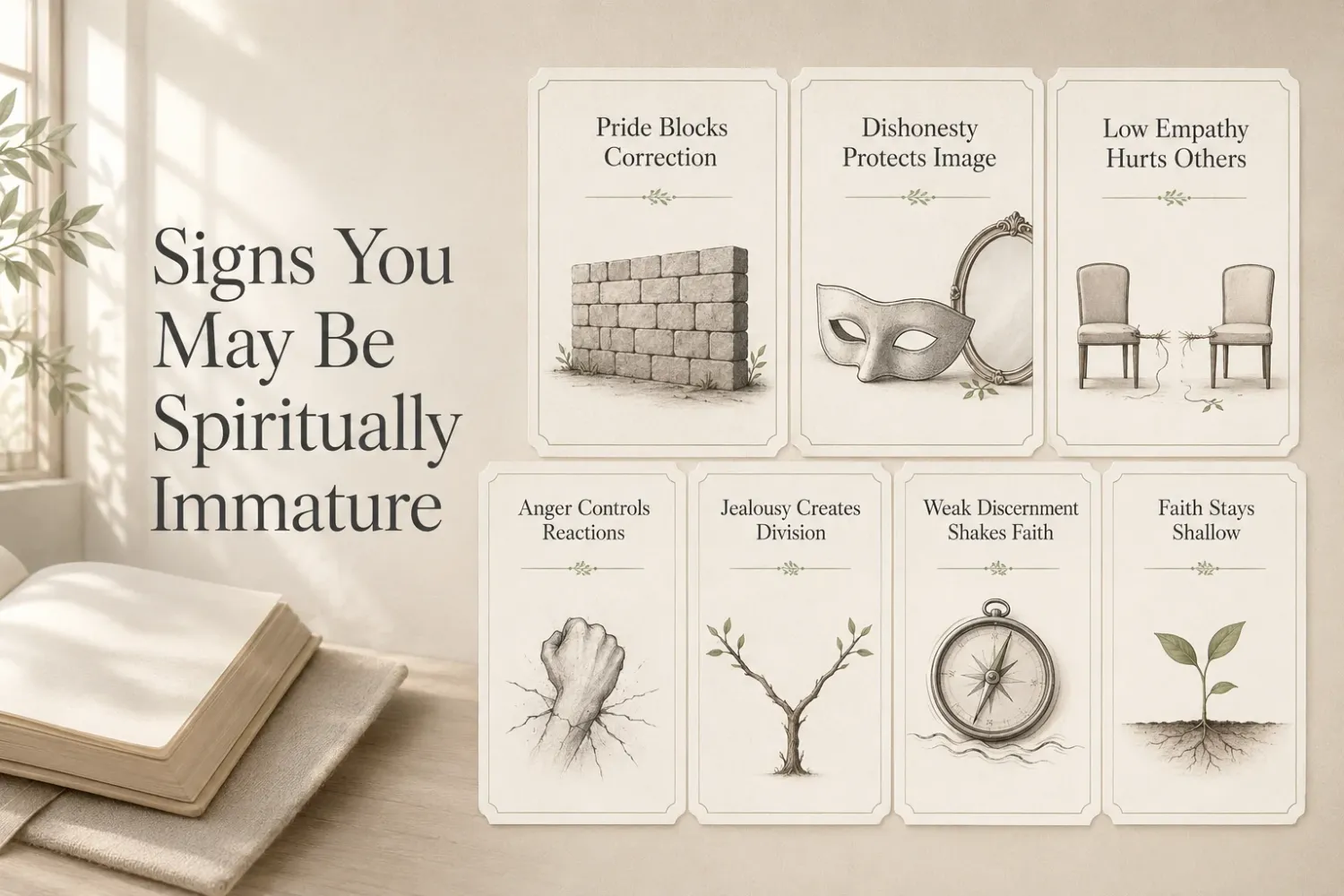
Spiritual immaturity signs are not meant to help you judge other Christians. They are meant to help you examine your own heart before God.
The goal is not to ask, “Who do I know like this?” The better question is, “Lord, where do You want to grow me?”
Pride Blocks Correction
Pride in the Christian life often sounds spiritual on the outside but resists truth on the inside. It may say, “I already know that,” “God told me,” or “They are just attacking me,” when the real issue is an unwillingness to be corrected.
A proud heart can turn every correction into persecution. It can also use spiritual language to avoid accountability.
Godly correction is not always comfortable, but it is often one of the tools God uses to mature us. When correction comes from Scripture, wise counsel, or loving authority, humility asks, “Is there truth here that I need to receive?”
Dishonesty Protects Image
Christian pride and dishonesty often work together. Pride wants to look mature. Dishonesty helps protect the image.
This can show up as exaggerating spiritual experiences, hiding sin, giving partial truths, blaming others, or pretending to be fine when the heart is not fine. Dishonesty keeps a person trapped because healing begins where truth is welcomed.
A maturing Christian tells the truth faster. They do not need to manage every impression. They can say, “I was wrong,” “I need help,” or “I am struggling,” without believing their whole identity has collapsed.
If you recognize patterns of hidden shame or self-protective lies, deeper healing may be needed. AIIIH’sinner healing group coaching through Disarming Lies may be a helpful next step for learning how God’s truth confronts false beliefs.
Low Empathy Hurts Others
A lack of empathy Christian pattern can be easy to miss because it may hide behind being “truthful” or “bold.” Truth matters, but truth without love often wounds.
Low empathy may look like dismissing someone’s pain, correcting before listening, making every conversation about yourself, or being unable to see how your actions affect others.
Jesus never treated people as interruptions. He saw the weary, the sick, the ashamed, the grieving, and the spiritually confused. Growing in spiritual maturity means asking God to make your heart more like His.
Empathy does not mean agreeing with sin. It means seeing people clearly enough to love them wisely.
Anger Controls Reactions
Anger can reveal places where the soul is still immature. The issue is not that a Christian feels anger. Even righteous anger exists. The issue is when anger controls speech, decisions, relationships, and repentance.
Immature anger reacts quickly and reflects slowly. It interrupts, accuses, punishes, withdraws, or explodes. It often feels justified because the person focuses on what others did, not on how they responded.
James gives a sober warning:
“For the wrath of man worketh not the righteousness of God.” - James 1:20
If anger is a repeated pattern, it may be connected to pride, fear, resentment, trauma, learned behavior, or spiritual oppression. Do not overdiagnose it, but do not ignore it either. For deeper teaching on this pattern, read about the spirit of anger and hidden resentment.
Jealousy Creates Division
Jealousy is one of the clearest relational signs of immaturity. Paul named envy and strife as evidence that the Corinthians were still behaving in a fleshly way.
Jealousy compares gifts, callings, attention, relationships, ministries, and opportunities. It struggles to celebrate what God is doing in someone else because it feels forgotten or threatened.
Mature love can rejoice when another believer is blessed. It trusts that God does not need to take from one child to provide for another.
When jealousy grows unchecked, it creates division. It can lead to gossip, suspicion, competition, passive aggression, and quiet resentment. A maturing Christian brings jealousy into the light before it becomes relational poison.
Weak Discernment Shakes Faith
Spiritual immaturity often includes weak discernment. A person may be easily moved by every strong opinion, dramatic teaching, emotional experience, or online argument.
Discernment is not suspicion. It is the ability to test what is true, recognize what is false, and remain anchored in Christ.
Hebrews speaks about mature believers who have their senses trained through practice:
“But strong meat belongeth to them that are of full age, even those who by reason of use have their senses exercised to discern both good and evil.” - Hebrews 5:14
Discernment grows through Scripture, prayer, obedience, correction, and time. It also grows when a believer stops feeding constantly on confusion and begins sitting under sound teaching.
Faith Stays Shallow
A spiritually immature Christian may remain at the surface of faith. They may want comfort from God but not correction from God. They may want promises but not discipleship. They may want breakthrough but not surrender.
Shallow faith often depends on emotion. When life feels good, faith feels strong. When God feels quiet, faith becomes unstable.
Mature faith learns to seek God beyond feelings. It still prays when answers are slow. It still obeys when emotions resist. It still returns to Scripture when confusion rises.
If feeling distant from God is part of your struggle, the teaching on what to do when you do not feel God’s love may help you approach that distance with honesty and hope.
Can Spiritual Immaturity Hide Behind Religious Activity?
Yes, spiritual immaturity can hide behind religious activity. A person can attend services, serve publicly, pray loudly, quote Scripture, or hold a ministry role while still refusing private growth.
Religious activity can become a covering for an unhealed heart. It may give the appearance of maturity without the fruit of maturity.
Jesus warned about outward religion that does not match inward reality. The Pharisees knew religious language, but many resisted mercy, humility, and repentance. Their issue was not lack of activity. Their issue was a heart that resisted God while appearing devoted to Him.
This is why the fruit of the Spirit matters. Galatians 5 points to love, joy, peace, patience, gentleness, goodness, faith, meekness, and self-control. These are not stage gifts. They are heart fruit.
A maturing Christian asks, “Am I becoming more like Jesus when nobody is watching?”
How to Start Growing in Spiritual Maturity
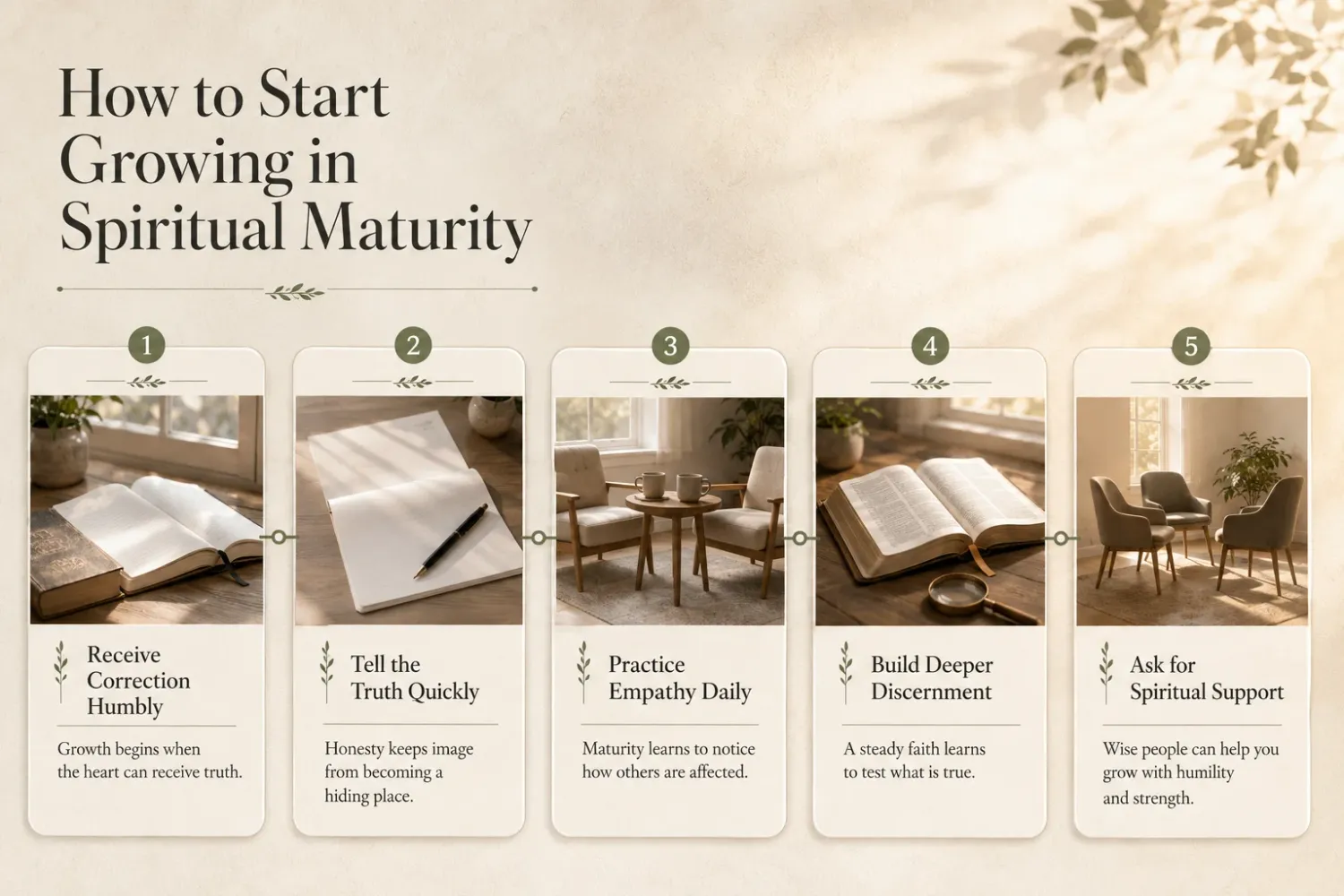
Growing in spiritual maturity is not about trying to look more impressive. It is about becoming more surrendered to Christ.
Growth usually happens through small, honest steps repeated over time. God often matures us through Scripture, repentance, relationships, correction, prayer, suffering, service, and the hidden work of the Holy Spirit.
Receive Correction Humbly
Start by asking God to show you where you resist correction. Pay attention to the moments when you become defensive, dismissive, or quick to explain yourself.
A simple prayer can help:
“Lord, help me receive truth without shame. Show me what is from You, and give me humility to respond well.”
Receiving correction does not mean accepting every accusation. Some correction is unwise, harsh, or false. But maturity listens before rejecting. It tests the message without using discernment as an excuse for pride.
Tell the Truth Quickly
Truth weakens the power of hidden sin, shame, and false identity. When you tell the truth quickly, you stop building a life around self-protection.
Start with God. Then, where appropriate, tell the truth to a trusted pastor, mentor, counselor, mature believer, spouse, or friend.
This may sound simple, but it is powerful: “I have not been honest.” “I am jealous.” “I reacted in pride.” “I need help.” “I sinned against you.”
Maturity grows when confession becomes more normal than hiding.
Practice Empathy Daily
Empathy can be practiced. Before responding to someone, slow down and ask, “What might they be carrying?” “How did my words affect them?” “Am I trying to understand, or am I trying to win?”
A mature Christian does not use truth as a weapon. They use truth to serve love.
This does not mean becoming passive. It means becoming Christlike. Jesus could confront sin without becoming cruel. He could show mercy without losing holiness. He could speak truth without needing to humiliate people.
Build Deeper Discernment
Discernment grows when the Word of God becomes more than information. Scripture must begin to shape your instincts, desires, speech, and decisions.
Build a steady rhythm of reading Scripture, praying honestly, and applying what God shows you. Avoid making every spiritual decision based on emotion, fear, urgency, or someone else’s opinion.
Also pay attention to what forms you. Constant outrage, gossip, shallow teaching, and fear-based content weaken discernment. Sound teaching, prayer, worship, wise counsel, and obedience strengthen it.
Ask for Spiritual Support
Some patterns are not solved by private effort alone. God often uses the body of Christ to help us mature.
Ask for spiritual support when you notice repeated cycles you cannot seem to break, such as chronic anger, dishonesty, fear, shame, relational chaos, or resistance to repentance.
Some patterns are simple immaturity. Others may connect to wounds, lies, fear, inner vows, or spiritual bondage. Wisdom does not overdiagnose, but it also does not pretend deeper issues are not real.
If you need help discerning what may be happening beneath the surface, you can reach out through AIIIH’s prayer and ministry support. If a repeated pattern may involve spiritual bondage, our one-on-one Deliverance sessions are available daily.
Biblical Discernment: Serving People Without Becoming Their Slave
A spiritually immature Christian is not disqualified from growth. The Lord is patient, but He is not passive. He loves His children enough to reveal what still needs healing, repentance, and surrender.
Do not use grace as an excuse to stay immature. Also, do not use conviction as a reason to hate yourself. Godly conviction brings you into the light so you can be changed.
The mature Christian is not the one who never sees weakness. The mature Christian is the one who brings weakness to God with honesty and keeps saying yes to the Holy Spirit.
A simple prayer may help:
“Father, show me where I am still immature. Teach me to receive correction, tell the truth, love others well, and grow in discernment. Heal what is wounded. Expose what is false. Strengthen what is weak. Make me more like Jesus. Amen.”
Grace does not leave you where you are. Grace trains you, restores you, and teaches you to walk in truth.
FAQs
Is spiritual immaturity the same as being a new Christian?
Spiritual immaturity is not always the same as being a new Christian. A new believer is expected to be young in faith and still learning. A person can also be a Christian for many years and remain immature if they resist correction, repentance, love, and deeper obedience.
Can a mature Christian still struggle with pride?
A mature Christian can still struggle with pride, but maturity changes how they respond to it. Instead of defending pride, they confess it, repent, and allow God to correct them. Maturity is not sinless perfection. It is a growing willingness to walk in truth.
How do I know if I lack empathy as a Christian?
You may lack empathy as a Christian if you often dismiss pain, correct before listening, make conflicts only about your feelings, or rarely consider how your words affect others. Ask God to soften your heart and help you love people with both truth and compassion.
Can prayer help me grow in spiritual maturity?
Prayer can help you grow in spiritual maturity because it brings your heart before God. But prayer should also lead to obedience, repentance, Scripture, humility, and wise support. Mature growth usually includes both spiritual dependence and practical response.
SUPPORT THIS MINISTRY
As a Catholic nonprofit, every dollar given is prayerfully used to build the Kingdom of God — on earth as it is in heaven. Through your generosity, we are able to continue proclaiming the Gospel, setting the captives free, and equipping the Body of Christ to walk in healing, deliverance, and true freedom. Your gift is not just a donation; it is an act of faith that multiplies into souls restored, families healed, and lives transformed by the power of Jesus Christ. We keep nothing for ourselves. All contributions go directly toward sustaining this ministry — providing the tools, technology, staff, and outreach necessary to reach more hearts with the mercy of God. Please prayerfully consider sowing into this mission. Together, we are answering Christ’s call to heal the brokenhearted, proclaim liberty to captives, and set free those who are oppressed.