Spirits of Fear: Signs, Roots, and How God Brings Freedom
Written by: Christopher Gomez
Fear can feel protective at first. It warns you, slows you down, and tries to convince you that staying hidden is the safest choice. But when fear begins shaping your thoughts, decisions, relationships, and identity, it is no longer functioning as wisdom. It has become a cage.
Part of our Strongman Demons teaching series, drawn from themes in Chris’ upcoming book, Where Are All the Saints, this teaching looks at the spirit of fear as a spiritual pattern that multiplies irrational fear and replaces trust in the Lord with coping mechanisms. The goal is not to make you afraid of fear. The goal is to help you recognize when fear has been given too much authority and return that place of trust back to God.
A spirit of fear often hides behind things that feel reasonable. It may look like caution, preparation, self-protection, people-pleasing, isolation, or the need to control every outcome. But underneath those patterns, fear is often training the heart to believe that safety comes from what we can manage, not from the Lord.
Key Takeaways
The spirit of fear multiplies irrational fears and creates false security through coping mechanisms.
Fear can control decisions, reactions, relationships, and identity without being obvious at first.
A fear pattern may look personal, emotional, or practical while still having a spiritual root.
Freedom begins when fear is exposed, renounced, and replaced with trust in the Lord.
What Is the Spirit of Fear?
The spirit of fear is a demonic influence that seeks to control a person internally by multiplying fear beyond what is reasonable or true. It is not the same as healthy caution. Healthy caution helps you respond wisely to real danger. A spirit of fear pushes the soul into irrational worry, anxious expectation, avoidance, and self-protection.
In the teaching from Where Are All the Saints, the demon of fear is also distinguished from the fear-based control spirit. Both involve fear, but they do not operate in the same way. The demon of fear primarily controls the host. The fear-based control spirit controls the host and often pressures people around them as well.
That distinction matters because not every fear pattern expresses itself through outward control. Some people under fear do not dominate others. They shrink, hide, agree, avoid, overthink, or cling to whatever makes them feel safe. Fear becomes private bondage before it ever becomes visible behavior.
The spirit of fear may even feel like a friend because it promises safety. It may say, “Do not speak up. Do not try. Do not trust. Do not move forward. Stay where you are safe.” But the safety it offers is not freedom. It is captivity with a softer voice.
How the Spirit of Fear Works
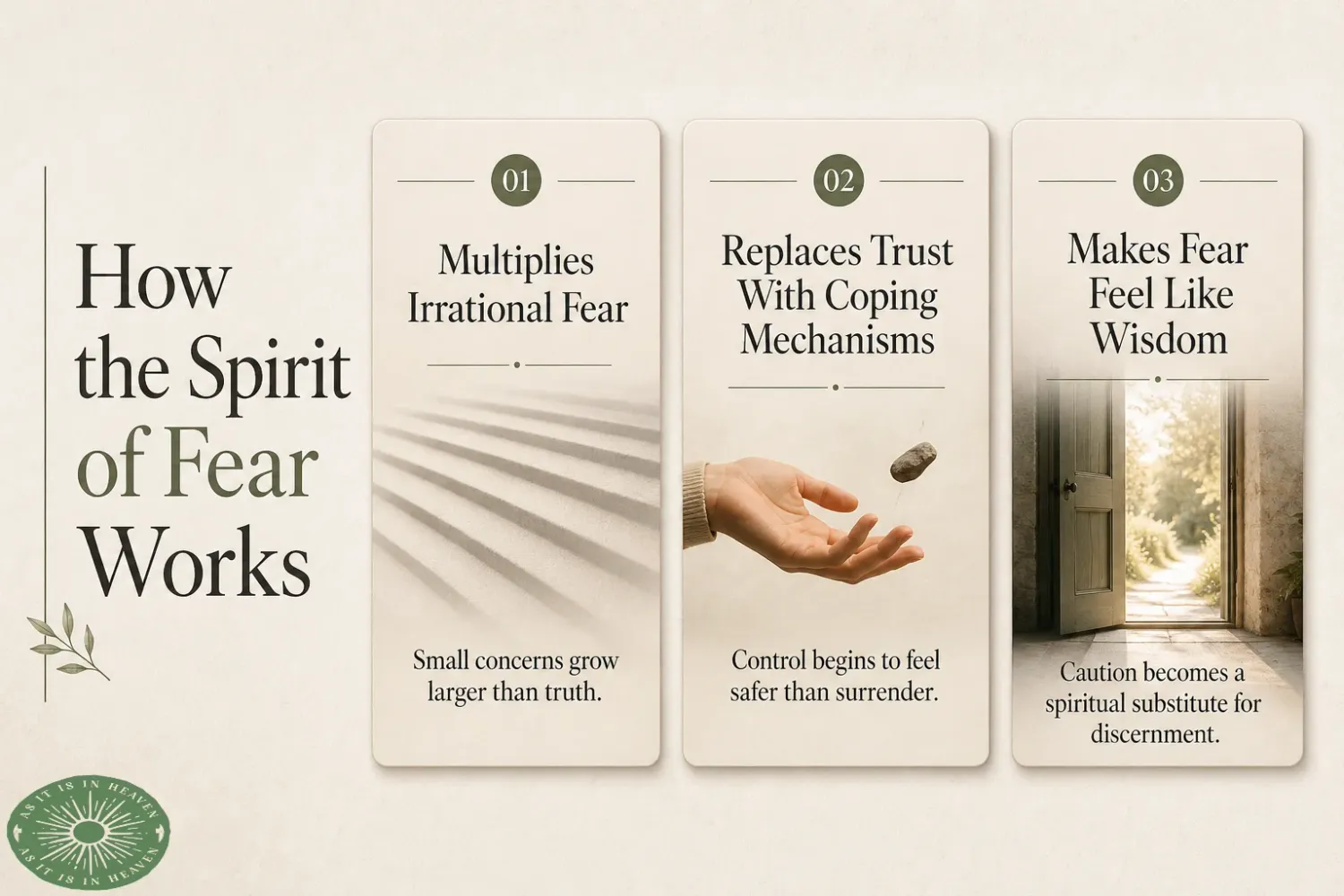
The spirit of fear works by exaggerating threats and weakening confidence in the Lord. It takes a fear that may have started with a real wound, memory, or concern, then multiplies it until the person feels controlled by something that may never happen.
Fear often builds a world inside the mind. The person begins living around imagined danger, possible rejection, future failure, or painful outcomes that have not arrived. Over time, the imagined threat can feel more powerful than God’s promise, presence, and peace.
Multiplies Irrational Fear
Irrational fear does not always feel irrational while you are experiencing it. It can feel urgent, convincing, and necessary. The mind may keep replaying the same concern, looking for proof that danger is near.
A spirit of fear uses that pressure to make a person reactive. Instead of discerning with peace, the person begins deciding from panic, shame, dread, or self-protection. The issue is not that the person feels fear. The issue is that fear begins giving instructions.
Many fears never actually happen, yet they still drain strength, joy, confidence, and obedience. The person may spend years preparing for a “boogeyman” that never comes while missing the life God was inviting them to live.
Replaces Trust With Coping Mechanisms
One of the clearest marks of a spirit of fear is the rise of coping mechanisms that provide false security. These mechanisms may not look sinful on the surface. They may look practical, familiar, or even comforting.
A coping mechanism becomes spiritually dangerous when it takes the place of confidence in the Lord. It becomes the thing a person clings to in order to feel safe. The heart begins to say, “As long as I have this, I will be okay.”
For one person, that may be constant reassurance. For another, it may be avoidance, control, isolation, people-pleasing, perfectionism, over-preparing, or refusing to take any step that requires trust. The heart begins to say, “As long as I have this, I will be okay.”
Fear Feel Like Wisdom
Fear often disguises itself as discernment. It says, “I am just being careful.” Sometimes that is true. God gives wisdom, and wisdom pays attention. But fear-driven caution produces a different fruit.
Godly wisdom can move with peace. Fear-driven caution usually produces paralysis, suspicion, avoidance, and heaviness. Wisdom helps a person obey God more clearly. Fear keeps a person from obeying at all.
A person controlled by fear may call it wisdom because fear has become familiar. But familiarity is not the same as truth. A pattern can feel normal simply because it has been present for a long time.
Signs of a Spirit of Fear
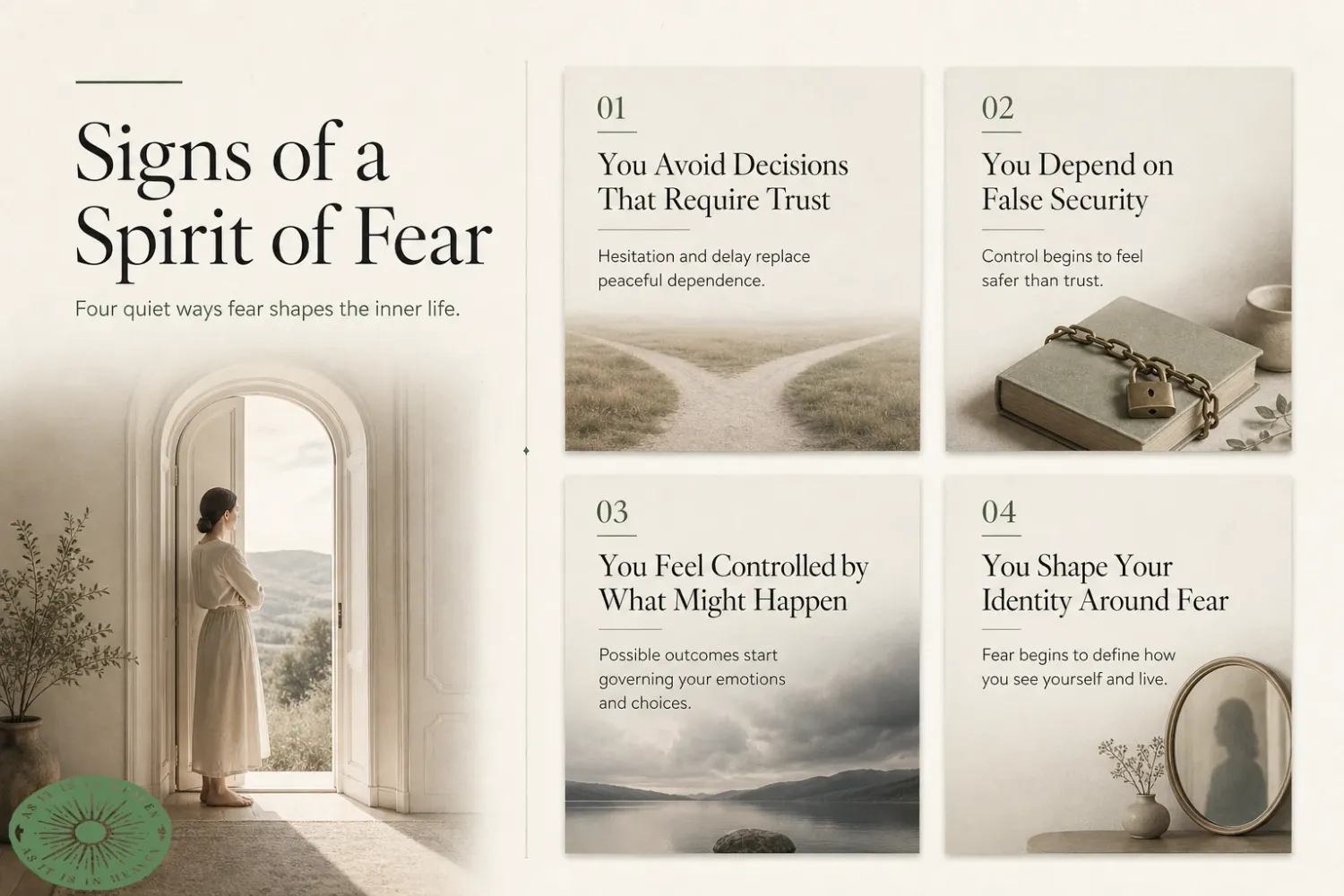
The spirit of fear can appear in obvious ways, such as panic, dread, or intense anxiety. But it can also appear in quieter patterns that seem like personality, habit, or past experience.
The signs are not meant to make every nervous moment spiritual warfare. They are meant to help reveal when fear has become a repeated pattern of control.
You Avoid Decisions That Require Trust
A common sign of the spirit of fear is avoidance. A person may delay decisions, avoid hard conversations, refuse new responsibilities, or stay in familiar places even when God is calling them forward.
The fear may not say, “I am afraid.” It may say, “Now is not the time,” “I am not ready,” or “Something bad might happen.” Those thoughts may sound reasonable, but the pattern becomes clearer when every step of faith is delayed.
Avoidance brings temporary relief, but it also teaches the heart that fear should be obeyed. Over time, the person may become more afraid of movement than of bondage.
You Depend on False Security
A coping mechanism can become a hiding place. It may be a routine, person, habit, environment, object, or behavior that makes the person feel safe apart from trusting God.
The issue is not whether comfort is always wrong. God is kind, and comfort has a place. The issue is whether comfort has become a substitute for confidence in the Lord.
When something cannot be surrendered without panic, fear may be attached to it. The person may feel unable to function unless the coping mechanism remains in place. That is not peace. That is dependence.
You Feel Controlled by What Might Happen
The spirit of fear often keeps a person trapped in future-focused dread. The mind becomes filled with “what if” scenarios. What if I fail? What if they reject me? What if something goes wrong? What if I am not safe?
Some planning is wise. But fear-driven planning has no rest in it. It does not lead to clarity. It leads to exhaustion.
When possible outcomes begin controlling present obedience, fear has gained influence. The future becomes louder than God’s voice, even though the feared outcome may never happen.
You Shape Your Identity Around Fear
Fear does not only affect what a person does. It can affect who a person believes they are. In the chapter testimony, one team member realized after deliverance and inner healing that a core belief had been driving him: he believed he was “a nobody.”
That belief produced fear, and fear produced people-pleasing. He avoided rocking the boat, tried to keep others happy, and shaped his behavior around being accepted. The coping mechanism was not random. It was tied to a deeper wound in identity.
The spirit of fear often attaches itself to false identity statements. I am unsafe. I am unwanted. I am powerless. I am a nobody. Once that belief is exposed, God can begin healing the place where fear found agreement.
Patterns Connected to Fear
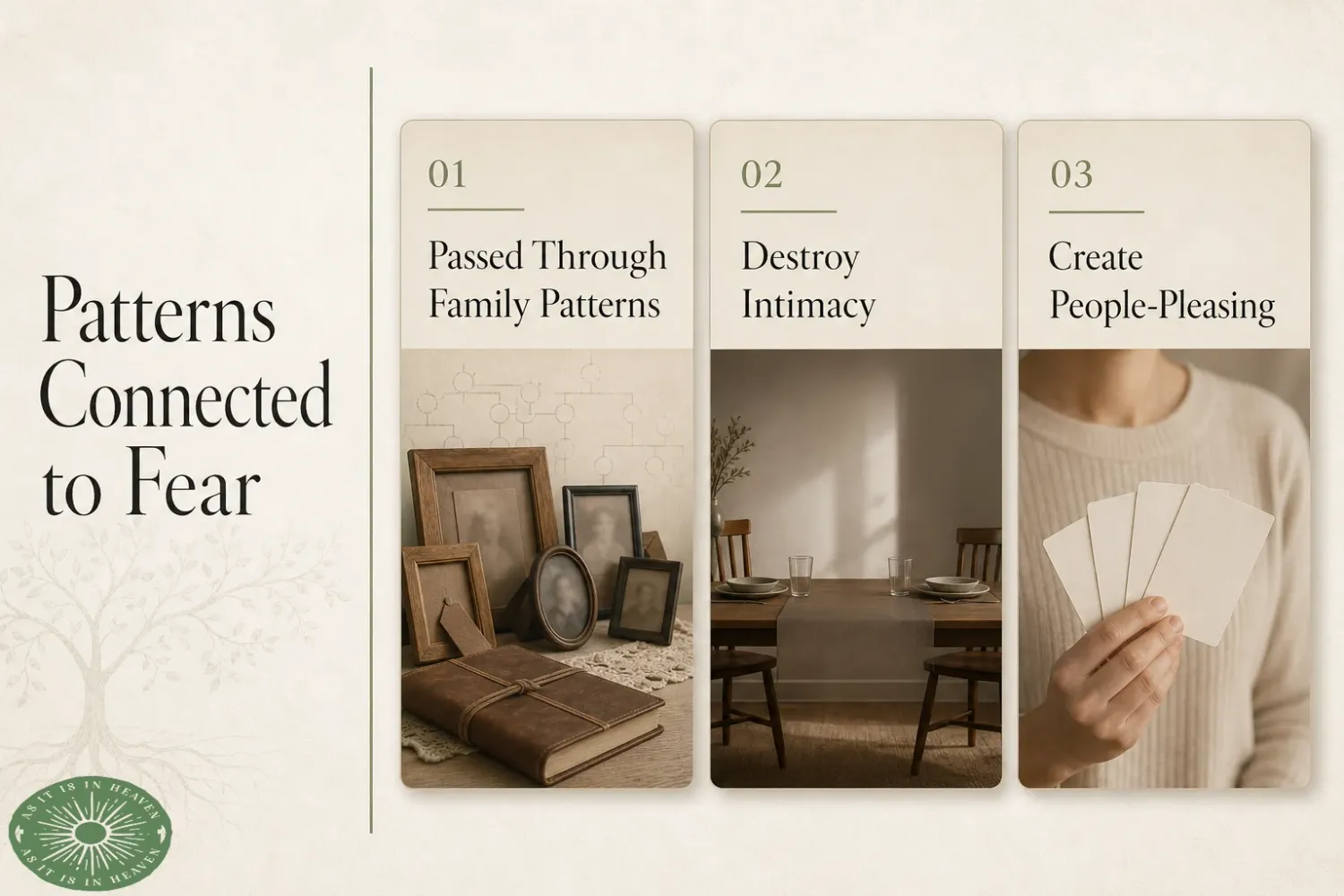
Fear rarely stays in one corner of life. It spreads into decisions, relationships, family patterns, and how a person responds to pressure.
The chapter gives a clear example of fear affecting a family line. A woman needed deliverance from the spirit of fear after years of being afraid of the dark. Her father had lived under intense fear of a break-in, sleeping on the sofa with a gun in his hand. What began as fear in one life affected the atmosphere of the home and then touched the daughter.
Passed Through Family Patterns
A fear pattern can become normalized in a family. Children may grow up learning that the world is unsafe, people cannot be trusted, danger is always near, or peace depends on control.
Not every inherited fear is demonic, and not every anxious family pattern should be treated carelessly. But spiritual patterns can travel through example, agreement, trauma, and repeated behavior. A child may learn fear before they have language for it.
When fear has moved through a family, the answer is not blame. The answer is discernment, repentance where needed, healing, and deliverance. God can break what has been repeated.
Destroy Intimacy
Fear often isolates people from the relationships they need. In the family example, the father’s fear led him away from his wife and into a pattern of self-protection. His coping mechanism may have made him feel safer, but it damaged connection.
Fear can make closeness feel dangerous. It can cause a person to withdraw, over-control, suspect others, or avoid vulnerability. The result is often loneliness, even when the person believes they are only trying to protect themselves.
God does not heal fear by shaming the fearful person. He exposes the false protection so the person can return to real security in Him.
Create People-Pleasing
People-pleasing is often fear wearing a friendly face. It may look kind, agreeable, and helpful, but underneath it can be driven by fear of rejection, fear of conflict, fear of being disliked, or fear of being seen as unimportant.
The team member’s testimony shows how fear can quietly become a puppet master. He did not realize how much fear influenced his reactions, choices, and habits until after deliverance. Once the fear was exposed, he could see how much of his life had been shaped by the need to prove he was somebody.
True love serves freely. People-pleasing serves anxiously. Love can say yes or no with peace. Fear says yes because it is terrified of what might happen if it does not.
Spiritual Roots of the Spirit of Fear
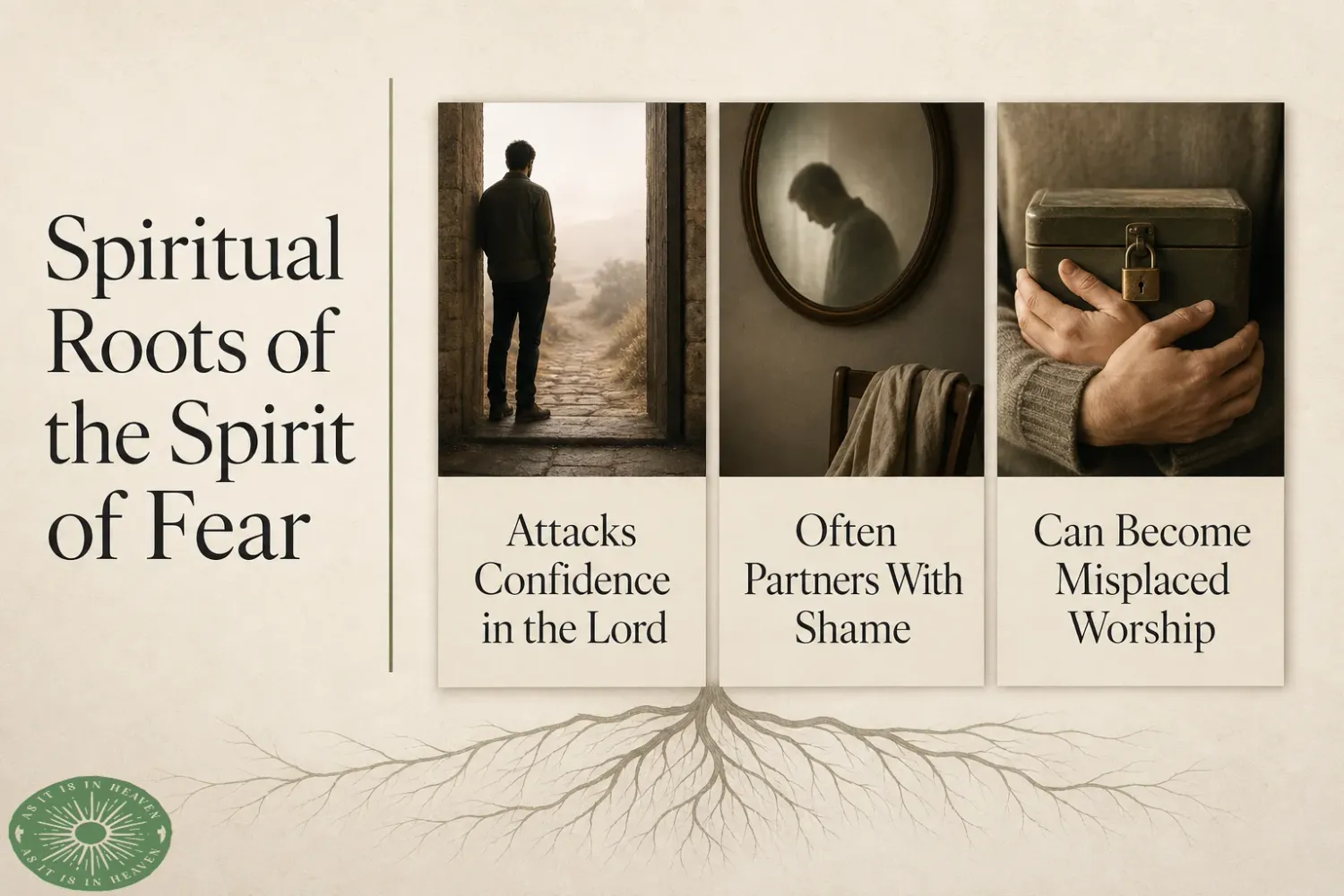
Fear gains strength when it finds agreement in the heart. That agreement may come through trauma, family patterns, lies about identity, shame, spiritual oppression, or repeated decisions made from self-protection.
The spirit of fear wants a person to place confidence in something other than the Lord. That is why the issue is not only emotional. It is also spiritual. Fear competes with trust.
Attacks Confidence in the Lord
Psalm 34 gives a beautiful picture of God’s answer to fear. David sought the Lord, and the Lord delivered him from all his fears. Those who look to Him become radiant, and their faces are not covered with shame.
Fear pulls the eyes inward or outward. It makes a person look at danger, weakness, rejection, failure, and what might go wrong. Deliverance turns the eyes back to the Lord.
When fear is broken, shame begins to lose its covering power. The person does not have to live hidden, diminished, or defined by dread. God restores radiance where fear produced heaviness.
Often Partners With Shame
Fear and shame often work together. Fear says, “Hide because something bad may happen.” Shame says, “Hide because something is wrong with you.” Together, they can keep a person small, silent, and afraid to be seen.
The chapter connects deliverance from fear with the removal of shame through Psalm 34. When fear is active, others may see a person as unimportant, depressed, fearful, or covered in shame. The person may not even realize how much fear has shaped their countenance and presence.
God does not expose shame to humiliate His people. He exposes it to remove it. Fear covers the face. The Lord restores radiance.
Can Become Misplaced Worship
When fear becomes the ruling voice, it takes a place in the heart that belongs to God. The person may not consciously choose that, but their life begins to revolve around what fear demands.
That is why fear is not a small issue when it becomes controlling. It can direct attention, decisions, relationships, and identity. It can train a person to obey imagined danger more quickly than the voice of the Lord.
Freedom requires returning trust to its rightful place. The Lord becomes the refuge again, not the coping mechanism, not control, not avoidance, and not the approval of people.
How to Break the Pattern of Fear
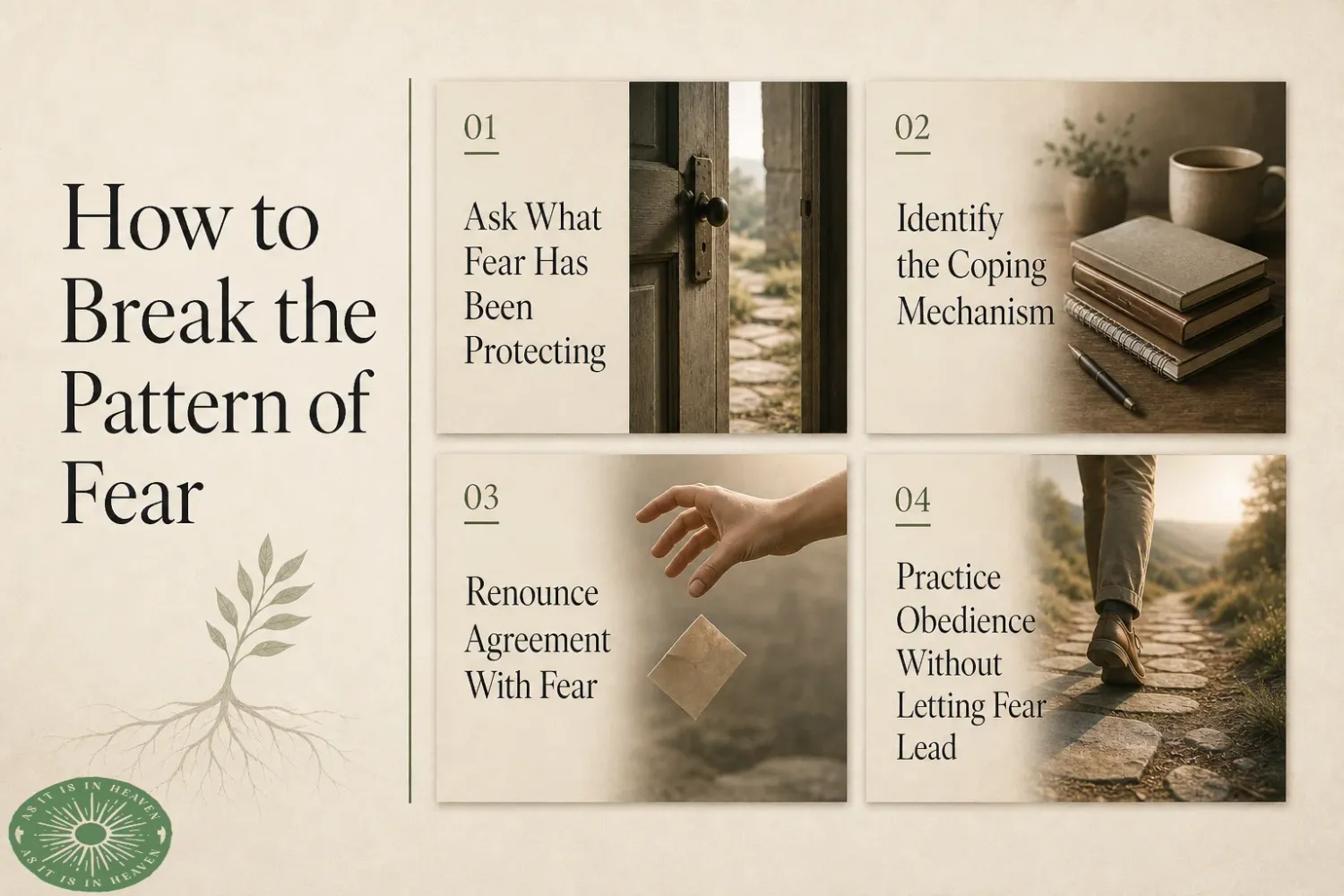
Breaking a fear pattern begins with bringing fear into the light. Many people try to manage fear without ever asking what it is attached to. But fear often has roots, agreements, and coping mechanisms that need to be named.
God’s freedom is not shallow. He does not simply tell His people to stop being afraid and leave them powerless. He brings truth, deliverance, healing, and renewed confidence.
Ask What Fear Has Been Protecting
A helpful first step is to ask what the fear has been trying to protect. Fear may be guarding an old wound, a false identity, a painful memory, or a place where trust was broken.
The question is not meant to validate fear as lord. It is meant to expose the lie beneath the pattern. A person may discover fear has been protecting a belief like, “I am not safe,” “I will be rejected,” or “I do not matter.”
Once that belief is named, it can be brought before the Lord. Fear loses power when the agreement beneath it is broken.
Identify the Coping Mechanism
The next step is to identify what fear has been using as a substitute for trust. The coping mechanism may have helped the person survive a season, but it was never meant to rule their life.
Ask simple questions. What do I reach for when I feel unsafe? What do I refuse to surrender? What do I use to avoid obedience? What makes me feel secure apart from God?
The answer may reveal the “teddy bear” fear has given you. It may look harmless, but if it has become the foundation of your security, the Lord may be inviting you to release it.
Renounce Agreement With Fear
Fear must be resisted with spiritual clarity. When a person recognizes that fear has been ruling their thoughts, identity, or choices, they can renounce agreement with it and return that place of authority to Jesus.
Renouncing fear is not pretending fear was never felt. It is refusing to let fear remain enthroned. It is saying, “I will no longer treat fear as my protector, guide, or master.”
Prayer, repentance, inner healing, and deliverance may all be part of that process. Some patterns break quickly. Others require continued healing as the person learns to live from truth instead of fear.
Practice Obedience Without Letting Fear Lead
After fear is exposed, obedience often becomes the place where freedom is strengthened. The team member’s testimony included the ongoing practice of speaking up, sharing opinions, and confronting old people-pleasing habits.
That kind of obedience can feel uncomfortable at first. It may even feel scary. But as the person takes steps with God, fear loses its familiar grip.
Freedom is not only the absence of fear. It is the growing ability to choose God’s truth even when fear tries to speak.
Walking in Freedom From the Spirit of Fear
God does not deliver His people from fear so they can live recklessly. He delivers them so they can live in trust, wisdom, love, and soundness of mind.
Fear says safety comes through control. God teaches that safety is found in Him. Fear says hiding will protect you. God restores the courage to stand, speak, love, obey, and be seen.
When the spirit of fear is broken, the heart begins to recover what fear stole. Peace becomes possible. Joy returns. Shame lifts. Relationships can heal. Decisions can be made from faith instead of dread.
If you recognize the effects of fear in your life, do not turn that recognition into condemnation. Bring it to the Lord. Ask Him to expose the root, reveal the coping mechanisms, heal the wound, and remove every spiritual influence that has used fear to control you.
If you are experiencing the effects of this spirit in your life, we welcome you to our one-on-one Deliverance sessions, available daily, and our monthly healing call, held on the first Tuesday of every month.
FAQs
Can a spirit of fear affect one area more than others?
A spirit of fear can affect one area more than others, especially when fear is attached to a specific wound, memory, relationship, or identity belief. Some people feel fear most strongly around safety, rejection, conflict, money, health, or being seen.
Can the spirit of fear operate through other people?
The spirit of fear can operate through other people when their fear pressures, influences, or controls the atmosphere around them. That does not mean every fearful person is intentionally harming others, but fear can spread through behavior, reactions, and family patterns.
Can prayer alone break a fear pattern?
Prayer can break a fear pattern, but many people also need truth, repentance, inner healing, and deliverance. The deeper the root, the more important it becomes to let the Lord address both the spiritual influence and the wound where fear found agreement.
Why does fear feel personal if it may be spiritual?
Fear can feel personal because it often attaches to real pain, memories, personality patterns, or identity beliefs. A spiritual influence may use those personal places, but God brings freedom by dealing with both the fear and the deeper wound beneath it.
Can a fear pattern continue for years?
A fear pattern can continue for years when it is protected by coping mechanisms or treated as normal. Long-standing fear does not mean freedom is impossible. It often means the pattern needs to be exposed clearly and brought under the authority of Jesus.
Should every repeated setback be seen as spiritual warfare?
Not every repeated setback should be seen as spiritual warfare. Some patterns come from choices, trauma, wisdom gaps, or natural circumstances. Discernment matters. A repeated pattern becomes spiritually concerning when fear, bondage, false security, and resistance to God’s truth keep showing up together.
SUPPORT THIS MINISTRY
As a Catholic nonprofit, every dollar given is prayerfully used to build the Kingdom of God — on earth as it is in heaven. Through your generosity, we are able to continue proclaiming the Gospel, setting the captives free, and equipping the Body of Christ to walk in healing, deliverance, and true freedom. Your gift is not just a donation; it is an act of faith that multiplies into souls restored, families healed, and lives transformed by the power of Jesus Christ. We keep nothing for ourselves. All contributions go directly toward sustaining this ministry — providing the tools, technology, staff, and outreach necessary to reach more hearts with the mercy of God. Please prayerfully consider sowing into this mission. Together, we are answering Christ’s call to heal the brokenhearted, proclaim liberty to captives, and set free those who are oppressed.