
Martyr Spirit: Signs You Are Carrying Burdens God Never Gave You

Written by: Christopher Gomez
Table of Contents
2. What Is the Martyr Spirit?
3. How the Martyr Spirit Works
4. Signs of a Martyr Spirit
5. Spiritual Roots Behind the Martyr Spirit
6. How to Break Free From a Martyr Spirit
7. Discernment: Sacrifice, Servanthood, or Martyr Spirit?
8. Walk Out of False Burdens and Back Into Freedom
The martyr spirit often comes disguised as virtue. It can look like loyalty, service, sacrifice, and being the one everyone depends on. Yet beneath the surface, it leaves a person tired, resentful, unseen, and quietly angry that no one seems to notice how much they have carried.
Part of our Strongman Demons teaching series, drawn from my upcoming book, Where Are All the Saints. The point is not to shame sacrifice. True love does sacrifice. The problem begins when sacrifice becomes a prison, when suffering becomes an identity, and when carrying other people’s burdens replaces receiving healing from Jesus.
A person under this pattern may believe they are being noble, but the fruit often tells another story. Peace gives way to bitterness. Service turns into control. Love becomes a silent contract where others are expected to notice, appreciate, and repay what was never spoken clearly.
Key Takeaways
The martyr spirit often hides behind self-sacrifice that slowly becomes resentment.
A repeated need to feel needed can point to low self-worth and unhealed pain.
Healthy Christian service does not require living without boundaries.
Jesus brings freedom by healing the heart, restoring identity, and breaking false burdens.
What Is the Martyr Spirit?
The martyr spirit is a spiritual pattern that pushes a person to carry burdens God never assigned to them. It drives them to overextend themselves, absorb other people’s responsibilities, and then feel wounded when no one recognizes the cost.
It can appear friendly at first because it imitates compassion. A person may feel useful, needed, and even spiritually mature. But over time, the pattern produces exhaustion, resentment, and emotional pressure. The person gives more than they can give, then feels overlooked when others keep taking.
The martyr spirit is not the same as true Christian martyrdom. Biblical sacrifice flows from love, obedience, and surrender to Jesus. The martyr spirit twists sacrifice into identity. It teaches a person to find worth in being used, needed, or pitied.
How the Martyr Spirit Works
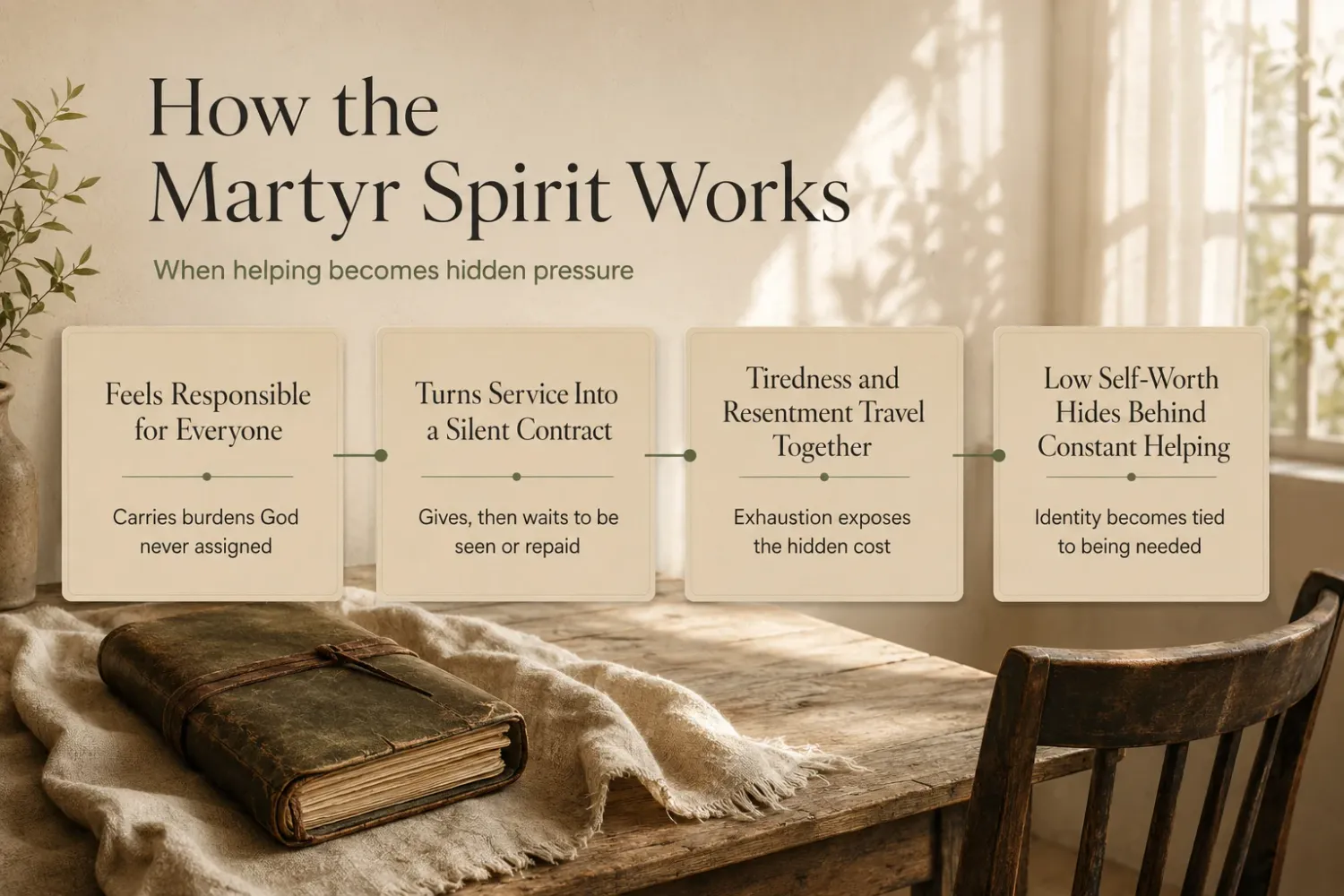
The martyr spirit often works through three connected patterns: self-sacrifice, victim mentality, and seeking validation. These patterns feed one another until the person feels trapped in a role they no longer know how to leave.
First, the person keeps putting others first, even when it damages their health, relationships, calling, or emotional stability. Then they begin to see themselves as the one who is always used, overlooked, or mistreated. Finally, they crave recognition for all they have carried, but the recognition never satisfies for long.
The spirit gains strength when the person believes their pain is proof of their value. Instead of asking, “Did God ask me to carry this?” they may think, “If I stop carrying this, I am selfish.”
Makes You Responsible for Everyone
One of the main ways this spirit works is by making you feel responsible for things that belong to other people. You may feel responsible for everyone’s emotions, choices, comfort, growth, and consequences.
That burden can feel spiritual, but it is often control in disguise. A person may keep stepping in because they cannot bear to watch others struggle, fail, or face the results of their own decisions. What begins as help becomes interference. What looks like love becomes fear.
Jesus carried the cross no one else could carry. You are not called to become the savior of your family, workplace, ministry, or community. When the martyr spirit is active, it pressures you to carry a role only Jesus can fill.
Turns Service Into a Silent Contract
The martyr spirit often serves without clear communication. A person gives, helps, pays, fixes, rescues, and absorbs pressure, but they rarely say what they need. They may not ask for help directly. Instead, they hope others will notice.
When people do not notice, resentment rises. The person may feel betrayed by expectations no one agreed to. They may think, “After everything I have done, how could they treat me like this?”
Healthy service is honest. It can say yes with freedom and no with peace. The martyr spirit struggles with both because it fears losing its identity as the needed one.
Tiredness and Resentment Often Travel Together
A person under this pattern often becomes tired in a way that rest alone does not fix. The body may be exhausted, but the deeper issue is the constant emotional weight of carrying other people’s burdens.
Resentment follows because the person keeps giving beyond grace. They do what they never had peace to do, then become angry that others accepted the help. Over time, they may become sharp, bitter, or emotionally unpredictable.
The martyr spirit wants that cycle to continue. It wants the person to keep sacrificing, keep resenting, and keep believing there is no way out.
Low Self-Worth Can Hide Behind Constant Helping
Many people under a martyr spirit do not appear insecure. They may look strong, capable, spiritual, and dependable. Yet beneath that strength, there can be a deep question: “Would people still value me if I stopped doing everything for them?”
Low self-worth often hides behind over-functioning. A person may stay in an unfulfilling relationship, job, family role, or ministry position because being needed feels safer than being free.
The Lord does not heal us by making us useless. He heals us by teaching us that our worth is not built on usefulness. We belong to Him before we perform, serve, rescue, or carry anything for anyone.
Signs of a Martyr Spirit
A martyr spirit can affect personal life, family relationships, ministry, and work. It does not always look dramatic. In many cases, it looks like a tired person who keeps functioning while inwardly feeling unseen and used.
The pattern becomes clearer when the same fruit keeps appearing across different areas of life. The faces may change, but the emotional cycle remains the same.
Common signs include:
You consistently put others first, even when it damages you.
You feel guilty when you rest or say no.
You feel unappreciated for what you do.
You silently expect others to recognize your sacrifice.
You feel resentful after helping people.
You attract people who take without giving back.
You stay in unhealthy jobs, ministries, or relationships because leaving feels selfish.
You have emotional blowups after long periods of silence.
You feel like the hero and the victim at the same time.
These signs do not mean every act of service is wrong. They reveal a pattern worth bringing before Jesus honestly. The question is not only, “Am I helping?” The deeper question is, “What is happening in my heart while I help?”
Spiritual Roots Behind the Martyr Spirit
The martyr spirit often attaches to unresolved pain, especially pain connected to rejection, abandonment, family dysfunction, religious pressure, or childhood wounds. A person may have learned early that love had to be earned through service, silence, or suffering.
When that pain is not healed, suffering can become familiar. The person may not like being mistreated, but they know how to function there. Peace may even feel uncomfortable because it does not match the role they learned to survive in.
The spirit then builds a false identity around pain: “I am the one who carries everything. I am the one no one appreciates. I am the one who suffers for the family, the ministry, the workplace, or the people I love.”
Religious Suffering Can Strengthen the Pattern
Religious teaching can make this pattern harder to recognize when suffering is glorified without pointing people to healing. In some Catholic environments, the phrase “offer it up” has been used in a way that makes people endure pain rather than seek Jesus until He heals them.
There is a holy way to unite suffering with Christ, but there is also a distorted way to make suffering into identity. The gospel does not call us to worship pain. Jesus heals the brokenhearted, restores the oppressed, and brings truth into places where religious language has covered unhealed wounds.
When people are praised for never having needs, never saying no, and never asking for help, the martyr spirit can hide in plain sight. It sounds spiritual, but it leaves people bound.
Childhood Pain Can Become Adult Over-Responsibility
Many adults who over-carry were children who had to grow up too fast. They may have managed a parent’s emotions, protected siblings, kept peace in the home, or learned that their needs were inconvenient.
Later in life, that child becomes an adult who still feels responsible for everyone. They may call it love, but often it is survival behavior that has not been healed.
Jesus does not condemn the child who learned to survive. He meets that place with compassion and truth. The adult no longer has to live from the old assignment of keeping everyone alive, calm, pleased, or dependent.
How to Break Free From a Martyr Spirit
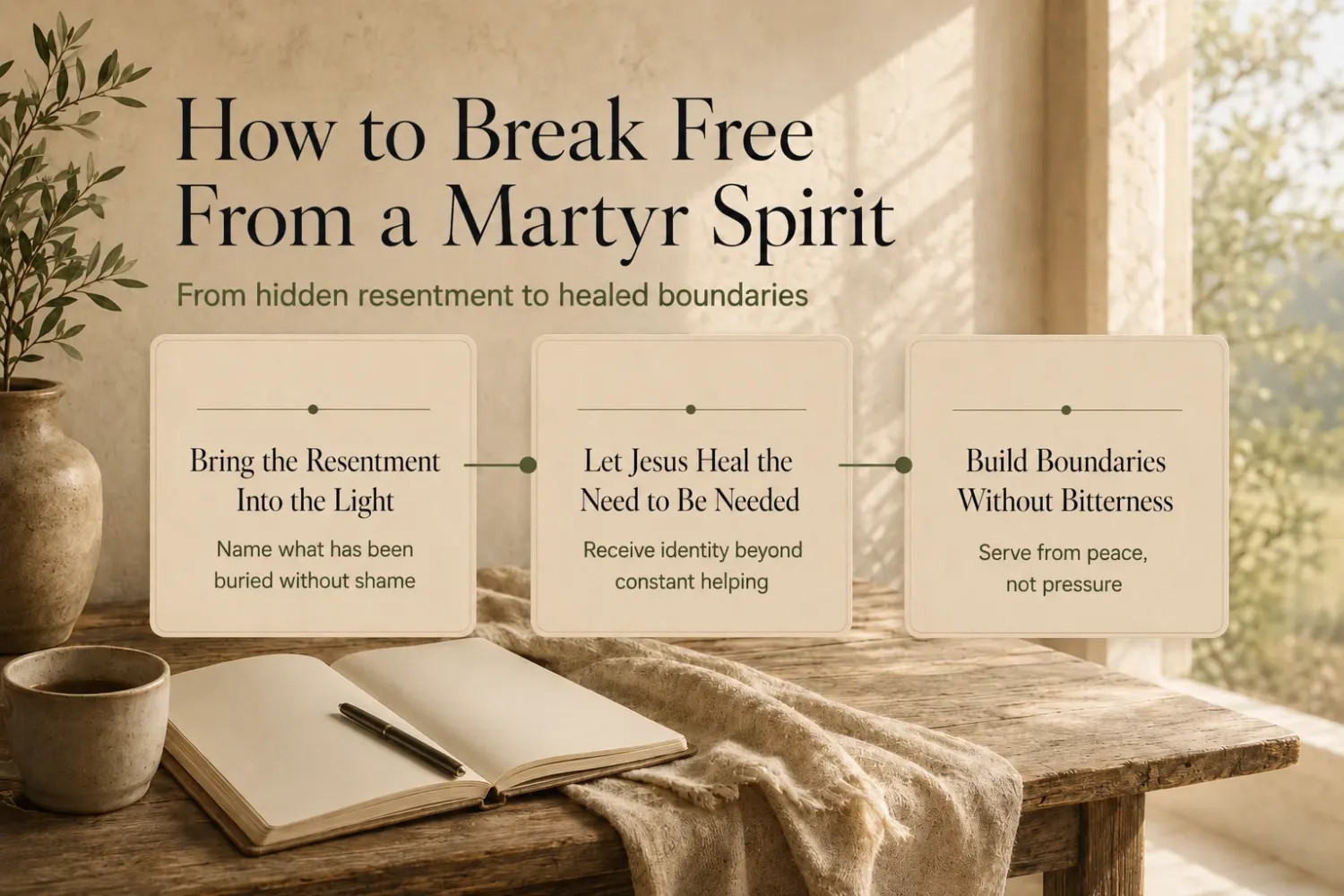
Freedom begins with honesty before Jesus. The martyr spirit loses power when the person stops calling bondage love and starts bringing the whole pattern into the light.
The first step is not to become selfish. The first step is to let Jesus show the difference between love and false responsibility. Love serves from freedom. False responsibility serves from fear, guilt, pressure, or the need to be seen.
Breaking the pattern often includes repentance, deliverance, healing, and practical change. The spiritual root must be addressed, but the daily habits must also change.
Bring the Resentment Into the Light
Resentment is not something to excuse, but it is something to examine. It often points to places where you have carried what God did not ask you to carry.
Instead of hiding resentment under religious language, bring it honestly to Jesus. Ask Him where you said yes without grace. Ask where you wanted recognition more than obedience. Ask where pain became part of your identity.
That kind of honesty is not condemnation. It is the beginning of healing.
Let Jesus Heal the Need to Be Needed
The martyr spirit feeds on the need to be needed. Deliverance breaks spiritual bondage, but healing restores the places where identity was wounded.
Ask Jesus to heal the belief that you only matter when you are useful. Let Him speak to the part of you that fears being forgotten, replaced, rejected, or called selfish.
When identity is restored, service becomes cleaner. You can help without needing to be worshiped for it. You can give without becoming bitter. You can stop without falling apart.
Build Boundaries Without Bitterness
Boundaries are not punishment. They are truth in action. A boundary says, “I can love you, but I cannot carry what belongs to you.”
For someone coming out of a martyr pattern, boundaries may feel harsh at first. That is because the old pattern treated self-abandonment as holiness. Healthy boundaries may feel unfamiliar, but they are often necessary for peace.
A simple boundary may sound like:
“I cannot take responsibility for that.”
“I am not available for this today.”
“I can help in this way, but not beyond that.”
“I love you, but I will not be spoken to that way.”
The goal is not to become cold. The goal is to become free enough to love without resentment.
Discernment: Sacrifice, Servanthood, or Martyr Spirit?
Not every hard assignment is a martyr spirit. Some obedience is costly. Some seasons require endurance. Some love is sacrificial. The key is to discern the fruit and the source.
Ask whether the burden is producing obedience, peace, humility, and love, or whether it is producing resentment, control, self-pity, and emotional exhaustion. God may ask you to serve deeply, but He will not build your identity on being used and ignored.
A true servant can be hidden without becoming bitter. A person under the martyr spirit may appear hidden, but inwardly they are demanding recognition.
Healthy Servanthood Has Grace on It
When God gives an assignment, He also gives grace for it. That does not mean it is always easy. It means His presence sustains what He has truly asked you to carry.
Healthy servanthood also allows rest, truth, and wisdom. Jesus withdrew from crowds. He did not heal everyone in every place at every moment. He only did what He saw the Father doing.
The martyr spirit hates that kind of obedience because it wants you driven by need, guilt, pressure, and fear. Jesus leads. The martyr spirit pushes.
Repeated Setbacks Should Be Tested, Not Assumed
Some repeated relational pain is spiritual. Some of it is emotional. Some of it is learned behavior. Often, it is a mixture.
Wisdom does not label every difficulty as a demon, but neither does it ignore spiritual patterns when the fruit is consistent. Bring the pattern to Jesus. Ask for discernment. Look at the repeated cycle, the emotional fruit, and the areas where you keep losing peace.
Freedom grows when discernment replaces confusion.
Walk Out of False Burdens and Back Into Freedom
The martyr spirit keeps people trapped by making bondage look noble. It tells them to keep carrying, keep suffering, keep rescuing, and keep waiting for someone to finally notice. Jesus offers something better than recognition. He offers healing, truth, deliverance, and a new way to love.
You do not have to abandon compassion to become free. You do not have to stop serving to break this pattern. You need Jesus to heal the places where service became identity, where pain became proof of worth, and where false responsibility replaced obedience.
When Jesus breaks the martyr spirit, love becomes cleaner. Boundaries become possible. Resentment loses its throne. You can serve from peace instead of pressure, and you can stop carrying burdens He never placed on your shoulders.
If you are experiencing the effects of this spirit in your life, we welcome you to our one-on-one Deliverance sessions, available daily, and our monthly healing call, held on the first Tuesday of every month.
FAQs
Can a martyr spirit affect one area of life more than others?
Yes, a martyr spirit can affect one area more strongly, such as family, ministry, work, or close friendships. The pattern often appears where a person feels most responsible, needed, or afraid to disappoint others.
Can a martyr spirit operate through religious language?
Yes, a martyr spirit can operate through religious language when suffering is treated as identity instead of something Jesus can heal. True faith does not require people to stay bound, resentful, or emotionally crushed.
Is every act of self-sacrifice a sign of a martyr spirit?
No, every act of self-sacrifice is not a sign of a martyr spirit. Godly sacrifice flows from love and obedience, while the martyr spirit often produces resentment, control, self-pity, and a need for recognition.
Why does saying no feel selfish when dealing with this pattern?
Saying no can feel selfish because the martyr spirit trains a person to measure worth by how much they carry. Healing helps restore the truth that boundaries can be loving, honest, and spiritually healthy.
Can deliverance help with a martyr spirit?
Yes, deliverance can help with a martyr spirit when the pattern has a spiritual root. Lasting freedom often also includes healing, repentance, renewed identity, and practical boundaries.
SUPPORT THIS MINISTRY
As a Catholic nonprofit, every dollar given is prayerfully used to build the Kingdom of God — on earth as it is in heaven. Through your generosity, we are able to continue proclaiming the Gospel, setting the captives free, and equipping the Body of Christ to walk in healing, deliverance, and true freedom. Your gift is not just a donation; it is an act of faith that multiplies into souls restored, families healed, and lives transformed by the power of Jesus Christ. We keep nothing for ourselves. All contributions go directly toward sustaining this ministry — providing the tools, technology, staff, and outreach necessary to reach more hearts with the mercy of God. Please prayerfully consider sowing into this mission. Together, we are answering Christ’s call to heal the brokenhearted, proclaim liberty to captives, and set free those who are oppressed.